The 2026 Gros Morne Playwrights’ Residency is now accepting applications.

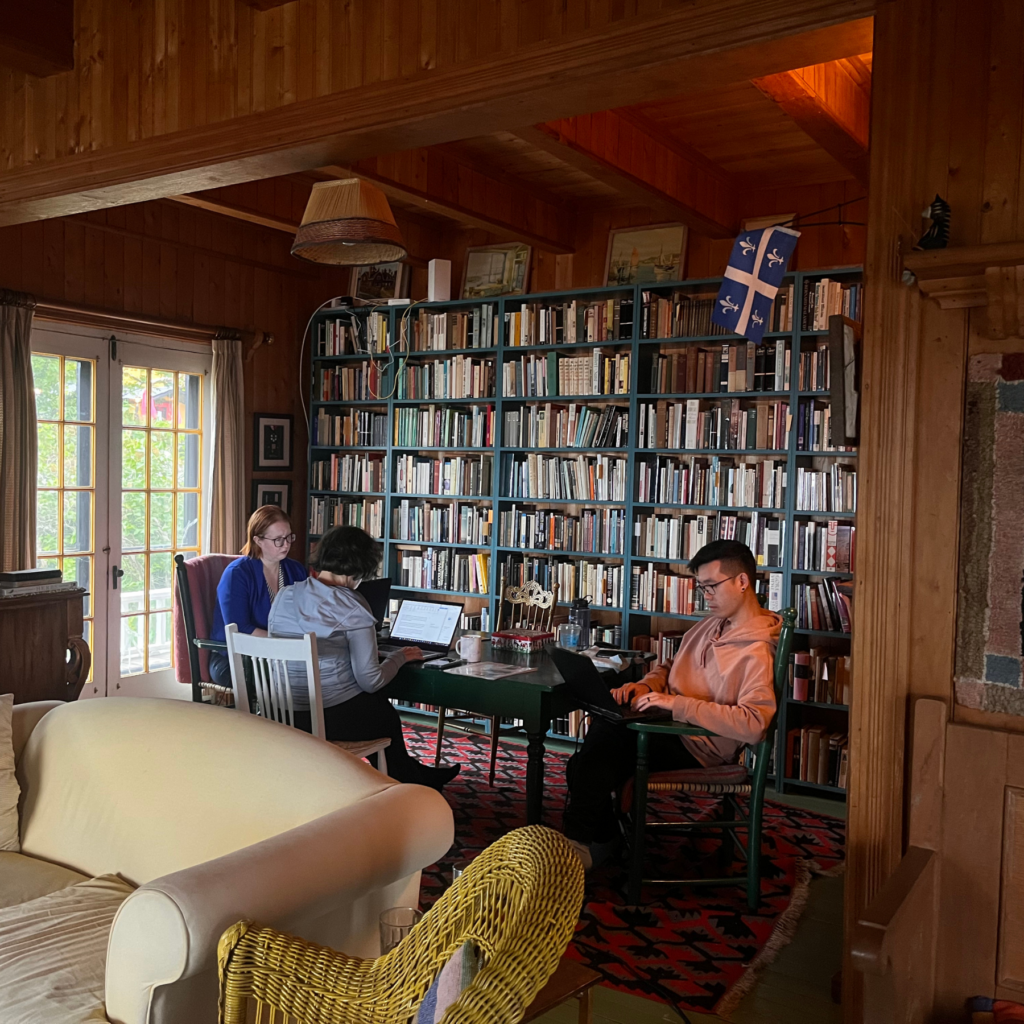
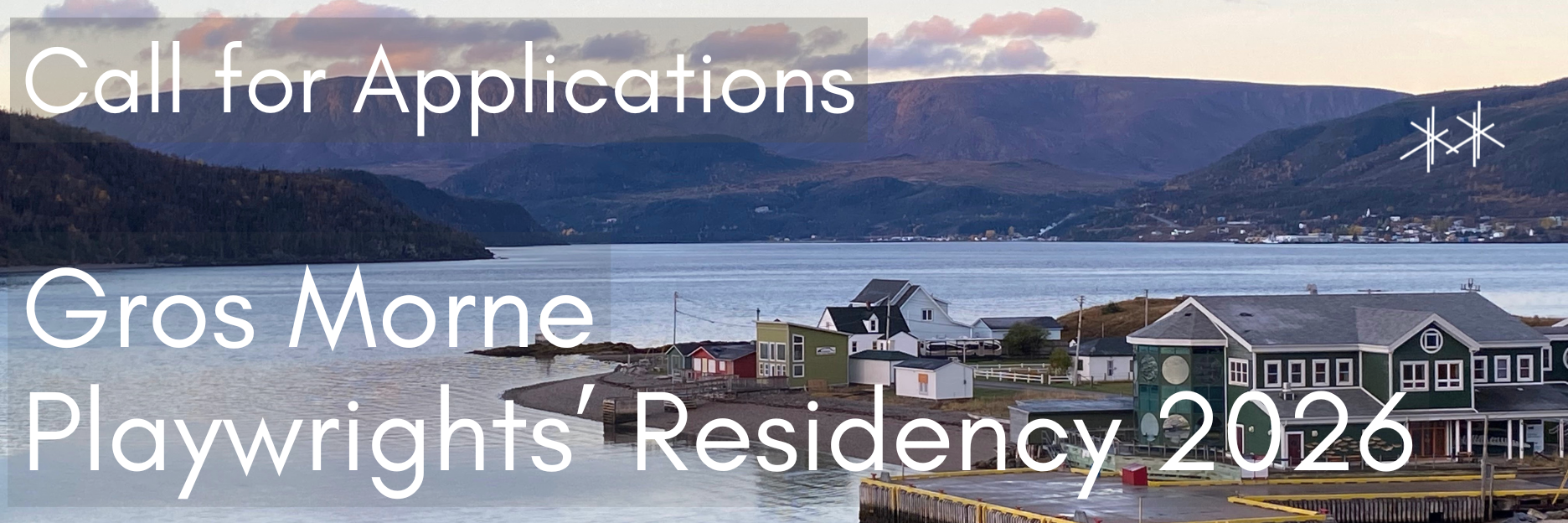
A view of the Bonne Bay Aquarium and Research Station at the Gros Morne National Park. On the upper left side, the words Call for Applications written in white. Beneath, the words Gros Morne Playwrights' Residency 2026 written in white.
APPLICATIONS ARE OPEN FOR THE GROS MORNE PLAYWRIGHTS’ RESIDENCY.

Application deadline: April 20, 2026, 11:59PM EDT

If you have any questions regarding accessibility, require assistance with this application, or would like to discuss alternative methods of applying, please contact accessibility@playwrights.ca.

Les candidats souhaitant postuler à la résidence d’auteurs dramatiques Gros Morne en français doivent se rendre sur le site web du CEAD et faire la demande auprès d’eux.

The Gros Morne Playwrights’ Residency will bring together seven playwrights living in Canada over a twelve-day period, from October 15 to 26, 2026.

Created by Playwrights’ Workshop Montréal (PWM) and the Centre des auteurs dramatiques (CEAD), this Residency is held in partnership with Artistic Fraud of Newfoundland, Creative Gros Morne, the Bonne Bay Aquarium & Research Station and with the vital support of the Cole Foundation.


About the Gros Morne Playwrights’ Residency

The Gros Morne Playwrights’ Residency is a dual-lingual residency that welcomes writers from across Canada to Gros Morne, Newfoundland and Labrador. This unique dual-lingual residency takes place at the Bonne Bay Aquarium & Research Station in Norris Point, located in Gros Morne National Park, Newfoundland and Labrador.

English language playwrights should apply through PWM and French language playwrights through the CEAD. Applications will be considered from across the country; three English and three French applications will be selected. A seventh spot is reserved for a playwright from Newfoundland and Labrador working in English. 

The residency will be led by Fatma Sarah Elkashef, Artistic Director of PWM, Aki Matsushita, dramaturg at PWM, and Sasha Dion, dramaturg at CEAD. The residency is an opportunity for solo writing, punctuated with moments of exchange and reading work in progress as a group. The host dramaturgs are available to read your work and engage in one-on-one conversations centred around your process and questions.

The Gros Morne Playwrights’ Residency provides playwrights with transportation, accommodation at Bonne Bay Aquarium & Research Station (private bedroom and bathroom), meals, an honorarium of $800.00, and dramaturgical support.

Read testimonials from the 2025 Gros Morne Playwrights’ Residency participants.


PWM welcomes all applications. While recognizing that the identity of each person is fundamentally plural, and multidimensional, we strongly encourage applications from artists who are: Indigenous (First Nations, Métis, and Inuit), Black, POC, racialized (including recent immigrants), 2SLGBTQQIPAA+, neurodivergent, living with disability, chronic illness and/or chronic pain. PWM is strongly committed to supporting a wide range of cultural identities and lived experiences, therefore we encourage applicants to self-identify in their application if they are comfortable doing so.


Eligibility

  • Be a Canadian citizen or hold permanent residency status in Canada;
  • Be a playwright, writing in English, and have had at least one play workshopped, published, or professionally produced;
  • Your application play should ideally be in the early stages of development (first draft or slightly beyond);
  • Be available for the whole residency;
  • Be willing to participate in group activities during the residency;
  • For playwrights writing in French, please visit the CEAD website. Please note that the CEAD only accepts applications from their members;
  • Please note that our expertise does not extend to musicals.

How to Apply

You can apply for the 2026 Gros Morne Playwrights’ Residency via our Google form, by April 20, 2026, 11:59PM EDT. Audio and video answers to some of the questions in the form are also welcomed.

In the form, you’ll be asked to provide the following information:

  • Your name, pronouns (optional), age (optional), and contact information; 
  • Geographical location you will be departing from to get to Gros Morne;
  • Geographical location you will be returning to;
  • A statement of your interest in the residency and how it will benefit your process (written, video or audio); 
  • A description of the play in progress (written, video or audio);
  • An excerpt of the play in progress (10 – 12 pages);
  • A CV (2 pages maximum) and a bio;
  • A copy of your last published, workshopped or produced play. (Please note, it must be a play other than the one you are applying to the residency with.)

Incomplete applications will not be considered. Selection will be made by a committee set up by PWM and CEAD. All applicants will receive a response by June 26, 2026.  Please note that PWM cannot provide feedback on applications. 

If you have any questions regarding the Gros Morne Playwrights’ Residency, please contact heather@playwrights.ca.

Preview the application form as a PDF.


Schedule for the Gros Morne Playwrights’ Residency

PWM organizes the travel for the artists, from their point of departure to the residency, and back again. 

October 15, 2026

Travel via plane and taxi to Norris Point, Newfoundland and Labrador (anyone departing West of Ontario will have to add a day of travel).

October 16-25, 2026

  • Unstructured writing time at Bonne Bay Aquarium & Research Station;
  • Individual sessions with residency dramaturgs as determined in collaboration with the playwright;
  • Daily sixty-minute group meetings to read and discuss the process;
  • 2 presentations by local artists; 
  • Shared catered dinner every evening;
  • A possible public reading of excerpts from the plays in progress with the local community.

October 26, 2026

Departure for home.

Places to create during the Gros Morne Playwrights’ Residency

Bonne Bay Aquarium & Research Station

Since 2002, the Bonne Bay Aquarium & Research Station, located on the magnificent west coast of Newfoundland and Labrador, has had the primary mission of expanding knowledge in marine ecology. In addition, the station also engages in community and artistic activities. Nestled in the small coastal community of Norris Point and with breathtaking views, it is equipped with laboratories, offices, a library, a multimedia theatre, an aquarium, and an attached building with individual bedrooms.

The residence is wheelchair accessible. However, the library and theatre space at the Bonne Bay Aquarium & Research Station, which is often used by the playwrights, requires the participant in a wheelchair to leave the residence, travel across the parking lot, into the main lobby entrance to access the library/theatre space.


Gros Morne National Park

Soaring fjords and moody mountains tower above a diverse panorama of beaches and bogs, forests and barren cliffs. Shaped by colliding continents and grinding glaciers, the ancient landscape of Gros Morne national park is a UNESCO World Heritage Site.


Logo of the Cole Foundation

Adaptation 101; From Inspiration to Action with Nick Carpenter

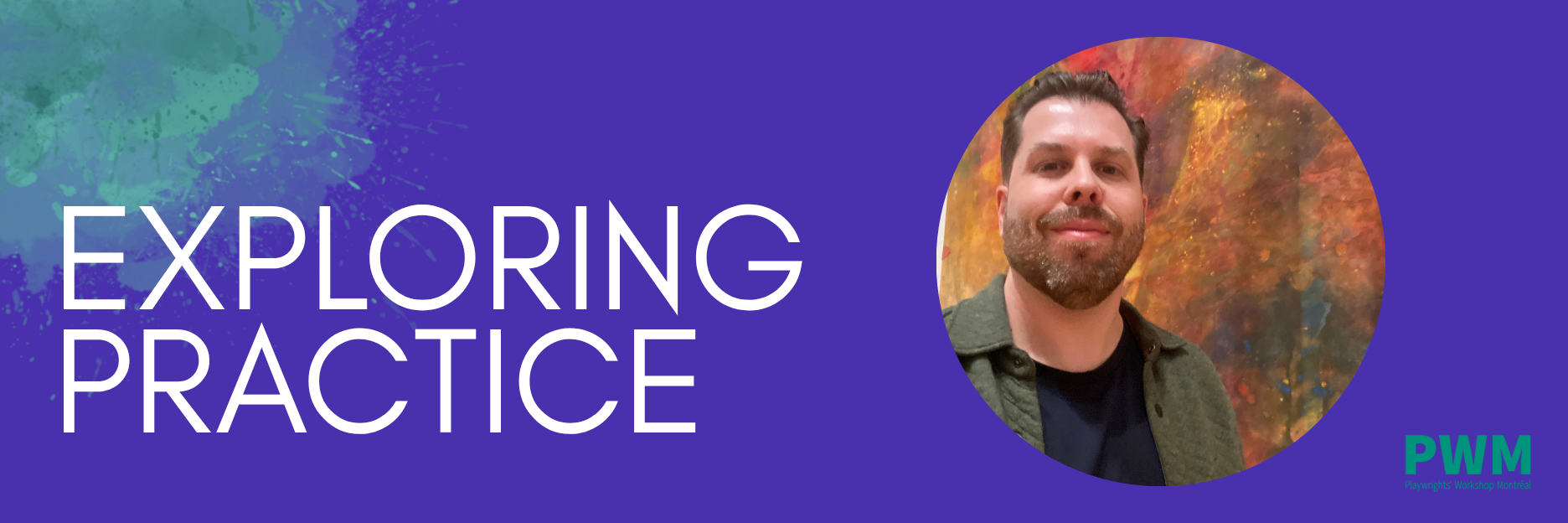
A royal blue background with a green paint spatter on the upper left corner. On the left side of the banner, written in white, the words Exploring Practice. To the right of these words, a headshot of the workshop facilitator, Nick Carpenter.
APPLICATION DEADLINE: Wednesday, February 25, 2026, 11:59 PM EST.

If you have any questions regarding accessibility, or require assistance with this application, please contact accessibility@playwrights.ca.

Participation is free. Workshop participants are selected based on the complementary experience of the group. We encourage playwrights at all levels of experience to apply.

The art and craft of theatrical adaptation is as old as humankind. It is one of the ways we transmit, celebrate, refresh, reframe and challenge the narratives and myths around which our communities are built.

What distinguishes dramatic storytelling from other forms and disciplines? Adapting for the stage gets us thinking about what a play is; what a play does. In this workshop, we will be weighing the building blocks and pertinent features of an original or ‘source’ document against the dramaturgical requirements of its new theatrical shape.

You are invited to unlock and explore the theatrical possibilities of a work not originally intended for the stage; a novel, short story, poem, essay, song…anything actually! If your source material happens to already be a play, then you will be examining and extending its theatrical potential — from play to musical for example; or old chestnut to bold new spin. Whatever your angle, it’s welcome!

Each session will be built around group discussion, exercises, sharing and feedback. Participant-generated material, as well as selected readings will serve as our inspiration.

Come with your ideas, your visions, your instincts. Or come with a project already launched. This workshop will meet you where you are in your process and will ignite, animate, and further your practice of theatrical adaptation.


SCHEDULE

Monday, March 23, 2026: 10AM to 2PM

Tuesday, March 24, 2026: 10AM to 2PM

Wednesday, March 25, 2026: 10AM to 2PM

Thursday, March 26, 2026: 10AM to 2PM

Friday, March 27, 2026: 10AM to 2PM

Participants are expected to be available for the duration of the scheduled sessions.

LOCATION

PWM Studio: 7250 Rue Clark #103, Montreal, Quebec, H2R2Y3

Click here for accessibility information and video tours of our location.


HOW TO APPLY:

If you are interested in applying, please fill out this Google Form by 11:59 PM EST on Wednesday, February 25, 2026.

Questions about this workshop can be sent to PWM’s Professional Development and Training Coordinator, Alexy Trottier, at alexy@playwrights.ca with the subject line: Exploring Practice with Nick Carpenter.

If you have any questions regarding accessibility, or require assistance with this application, please contact accessibility@playwrights.ca.

Click here for accessibility information and video tours of our location.

PWM welcomes all applications. While recognizing that the identity of each person is fundamentally plural, and multidimensional, we strongly encourage applications from artists who are: Indigenous (First Nations, Métis, and Inuit), Black, POC, racialized (including recent immigrants), 2SLGBTQQIPAA+, neurodivergent, disabled, living with chronic illness and/or chronic pain. PWM is strongly committed to supporting a wide range of cultural identities and lived experiences, therefore we encourage applicants to self-identify in their application if they are comfortable doing so.


ABOUT THE WORKSHOP FACILITATOR:

Nick’s plays, radio plays (CBC), short stories and librettos have been presented across Canada, the US, Britain and Germany. Recently a member of PWM’s Cross Cultural Adaptation Lab, he is developing a new work inspired by the Catalonian liturgical drama, El Misteri d’Elx.  His play Arco took 2nd place in Infinitheatre’s 2021 Write-on-Q Competition. Nick wrote the screenplay to the film Maz (Rendez-vous Québec Cinéma, 2018). His play Stained Glass won the Canadian Peace Play Competition in 2008 and was shortlisted for the Prism International Residency Award (2003). He is an alumnus of Tapestry Opera’s Lib Lab, the Banff Playwrights Lab, Theatre Centre Residency and Writers’ Units at NAC/GCTC and Playwrights’ Workshop Montréal.

To read more about Nick, click here.

Photo credit: Trine Veiss Mikkelsen


LEARN MORE ABOUT EXPLORING PRACTICE WORKSHOPS


THIS WORKSHOP IS FINANCIALLY SUPPORTED BY

2026 Glassco Translation Residency in Tadoussac

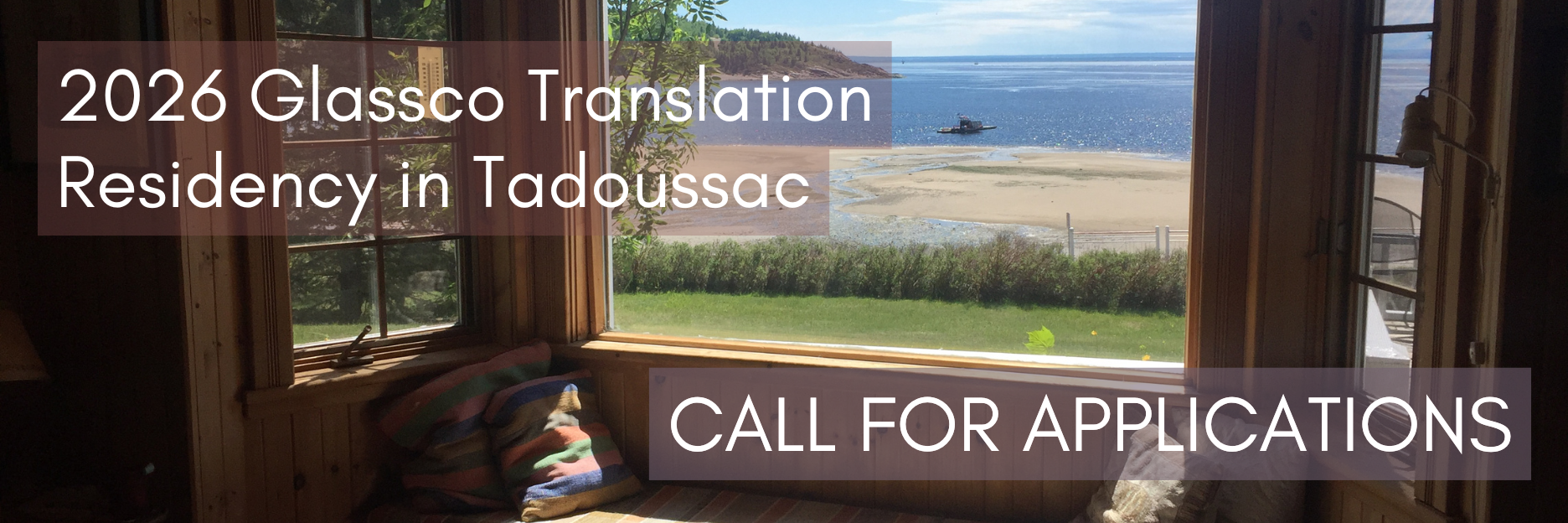
A view of Tadoussac from a window at Fletcher Cottage. The words 2026 Glassco Translation Residency in Tadoussac, Call for Applications written in white, with a brown highlight.
APPLICATIONS ARE OPEN FOR THE GLASSCO TRANSLATION RESIDENCY.


THIS THEATRE TRANSLATION RESIDENCY IS OFFERED BY PWM, IN PARTNERSHIP WITH THE COLE FOUNDATION, AND WITH THE SUPPORT OF THE FRIENDS AND FAMILY OF BILL GLASSCO.

Apply by February 22, 2026
Applicants will be contacted by March 31, 2026

If you have any questions regarding accessibility, require assistance with this application, or would like to discuss alternative methods of applying, please contact Heather at accessibility@playwrights.ca.

The Glassco Translation Residency offers a unique opportunity for playwrights and translators working in any language. Designed to explore the nuances of theatre translation and bring new work to life, the residency brings together translators and playwrights applying as a pair with a specific project. Over 10 days, participants live and work together at Fletcher Cottage in Tadoussac, developing their translations in a shared creative environment. Translations from and into any language are accepted. Work is done independently by each playwright-translator pair, and with the support of acclaimed Translation Dramaturg, Maureen Labonté. Artists gather from 5:30 – 6:30 pm, daily for a collaborative discussion and catered meal together each evening.

PWM welcomes all applications. While recognizing that the identity of each person is fundamentally plural, and multidimensional, we strongly encourage applications from artists who are: Indigenous (First Nations, Métis, and Inuit), Black, POC, racialized (including recent immigrants), 2SLGBTQQIPAA+, neurodivergent, disabled, living with chronic illness and/or chronic pain. PWM is strongly committed to supporting a wide range of cultural identities and lived experiences, therefore we encourage applicants to self-identify in their application if they are comfortable doing so.


The Glassco Translation Residency provides participants with transportation, accommodation, meals, an honorarium of $800.00, and dramaturgical support. Read more about staying at the Fletcher Cottage below.

Residency Dates: June 17 – 28, 2026

June 17: Arrival in Tadoussac
(travel may take 1 – 2 days depending on point of departure and return)
June 18 to 27 inclusively: Residency
June 28: Departure from Tadoussac

Artists must be available for the entirety of the dates above, as well as June 16 and June 29 should additional travel days be needed.

Eligibility Criteria

  • A key eligibility requirement is the availability of both the playwright and the translator to attend the residency together. Please note that PWM does not match playwrights to translators.
  • We aim to support translation projects in a variety of languages. We strongly encourage applications for translations in languages in addition to English and French. 
  • We accept applications of plays that are currently in the process of being translated. Please note that we do not fund the commission of the translation. 
  • The play should ideally have had a production in its original language. 
  • At least one component of the project (playwright, translator, commissioning theatre, or producing theatre) needs to be Canadian.
  • Residency participants will be selected by a committee. The number of translator-playwright pairs we can welcome is limited by the number of rooms available in the residency. The committee will make their selection based on the potential benefit to the playwright, translator and the project, the artistic strengths of the original text,  as well as the potential dynamic of the group.

How to Apply

You can apply for the 2026 Glassco Translation Residency via our Google form.

Audio and video answers to some of the questions in the form are also welcomed. Click here to view the form as a PDF.

You will be asked to provide the following information:

  • Name, pronouns (optional), age (optional), and contact information of the translator and playwright
  • Geographical location(s) the translator and playwright will be departing from to get to Tadoussac 
  • A description (written, video or audio) of the project which includes:
    • A description / history of the translator and playwright’s working relationship;
    • Why the work in question is being translated and how it will be impactful;
    • An indication of how the Residency will benefit the project, including how working in person with the playwright might move the translation forward;
    • Any details on production interest;
    • A description of the current stage of your translation;
    • Whether you are interested in dramaturgical conversations around translations, including with other artists at the residency;
  • Biographies and CVs of both the playwright and translator;
  • A copy of the play in its original language;
  • A sample of a previous translation work (10 – 12 pages); 
  • A sample of the translation work proposed for the residency if the work has already begun (10 – 12 pages)
  • For plays originally written in a language other than English or French, applicants are asked to provide a synopsis so the committee can better assess the work being translated.

If you have any questions with regard to the Glassco Translation Residency, please email our Programs Manager, Heather, at heather@playwrights.ca.


About the Glassco Translation Residency

The Glassco Translation Residency welcomes playwrights and translators from across Canada and internationally to come together for ten days in Tadoussac, Quebec, to work side by side on their translation projects. As the only translation residency of its kind in Canada, the Glassco Translation Residency is instrumental in bridging linguistic barriers, and supporting the development of vibrant new translations. This year marks the residency’s 20th anniversary.

Participants are provided with a unique opportunity to immerse themselves in creative collaboration and to share questions, thoughts, and ideas in a supportive environment. Translations into all languages are welcomed. Over the past 19 years we have offered space, time, and translation expertise to over 81 translations into languages including Cantonese, Catalan, Cree, English, Finnish, French, Innu-aimun, Italian, Portuguese, Spanish, Tamil, Tagalog and Urdu.

This year, Maureen Labonté steps into the role of Translation Dramaturg and Residency Host: Maureen will be joined by residency co-host and translation dramaturg, Aki Matsushita (PWM Dramaturg).


About the Glassco Translation Residency Facilitator

Maureen Labonté is a dramaturge, translator and teacher. She has coordinated a number of play development programmes in theatres and play development centres across the country including at the Banff Centre for the Arts, the Centre des auteurs dramatiques (CEAD) in Montreal, the National Arts Centre (Ottawa) and Playwrights’ Workshop Montréal. 

Maureen has also worked extensively as a translation dramaturge. Maureen was the Jury Chair for the Siminovitch Prize in Theatre from 2009 to 2012. From 2006 to 2011, she was Co-Director of the Banff Playwrights Colony at the Banff Center for the Arts. Previous to that, she worked at the Colony as resident dramaturge and then as Head of Program (2002-2005).

Maureen taught at the National Theatre School of Canada for twenty years starting in the mid-90’s. Maureen has also translated close to fifty plays into English. She lives in Montreal.

Details on the Stay

The house: The Glassco Translation Residency is held in Tadoussac, Québec, in an 18th century log home. There are 8 steps down to the entrance of the house. Each guest will have their own room with a writing area, and there are multiple communal areas to write throughout the home. The bathrooms are shared. The bathrooms are not wheelchair accessible. For detailed information or to ask specific questions about the bathrooms, accommodations, or workspaces, please email Heather at accessibility@playwrights.ca.

Travel: In order to arrive in Tadoussac, transportation is provided typically by train or airplane to Quebec City. From Quebec City, a three-hour taxi ride or a bus ride via Orleans Express (that crosses a ferry at one point) brings the participants to the house in Tadoussac. 

Meals: PWM hires a chef to make dinner each evening. Dinners are communal. Lunch and breakfast are on a self-serve basis. PWM asks all participants their food preferences and dietary restrictions ahead of time so that they can be accommodated as much as possible.

Internet: WiFi access throughout the house has been recently optimized and is suitable for working. However, it may not be suitable for video calls and streaming in certain areas, and service interruptions are possible due to the location.

The Glassco Translation Residency in Tadoussac is made possible through our partnership with the Cole Foundation’s Intercultural Conversations Program, the dedication of Residency Producer Briony Glassco, and the support of the friends and family in memory of the great Canadian theatre artist, Bill Glassco. We are also grateful to the Canada Council for the Arts, the Conseil des arts et des lettres du Québec, and the Conseil des arts de Montréal for their ongoing support.


Logo of the Cole Foundation
friends and family of Bill Glassco
Canada Council logo
CALQ_logo
CAM Logo

Building Your Grant Proposal with Jesse Stong

A blue background with a green splatter on the upper left side. Beneath, the words Exploring Practice in white. To the right, a headshot of workshop facilitator, Jesse Stong. To its right, the PWM logo in green.
Application Deadline: sunday, December 14TH, 2025 AT 11:59PM EST.

If you have any questions regarding accessibility, or require assistance with this application, please contact accessibility@playwrights.ca.

Strong grant writing skills are essential for any artist looking to bring their creative projects to life. This online workshop offers participants the opportunity to clearly articulate their project ideas through realistic timelines and budgets, while learning practical tips for crafting innovative, authentic, and compelling proposals that stand out to funders.

Participants will build the foundation of their project grant in a shared Zoom room, with collaborative feedback. They’ll learn more about where to apply and when, and how to build a clear and powerful application by developing engaging writing samples. By the end of this Exploring Practice, each participant will come away equipped to seek diverse sources of funding, with guidance on partnership-building for the future of their proposed project. This workshop is infused with motivational insights, aimed to empower participants to not only write, but enjoy writing grant applications! 

This Exploring Practice will provide two group sessions on Jan 26 – 27, followed by one-on-one time with Jesse for individualized support. Individual meetings will be scheduled based on participant availability. 

Participation is free. Workshop participants are selected based on the complementary experience of the collective group. We encourage all levels of experience to apply.

“Building Your Grant Proposal” is co-presented  by Playwrights’ Workshop Montréal (PWM) and the Quebec Drama Federation (QDF), with support from le Conseil de la formation continue (CFC).


SCHEDULE

Monday, January 26: 11AM to 3PM (Group session)

Tuesday, January 27: 11AM to 3PM (Group session)

Wednesday, January 28: No workshop

Thursday, January 29: Individual Meetings (1.5 hours/meeting)

Friday, January 30: Individual Meetings (1.5 hours/meeting)

Participants are expected to be available for the duration of the group sessions.

LOCATION

Remote (Zoom)

NOTE: The workshop is participatory in nature. Those taking part should come to the workshop with a project/residency idea that they are genuinely interested in developing a grant proposal for. This idea can be fully developed or a seed of a new project. An integral part of this workshop is in supporting the ideas of others and contributing to the group discussions.


HOW TO APPLY:

If you are interested in applying, please fill out this Google Form by 11:59 PM EST on Sunday, December 14, 2025. All applicants will receive a response during the week of December 19 informing them of the outcome of their application. 

Questions about this workshop can be sent to PWM’s Professional Development and Training Coordinator, Alexy Trottier, at alexy@playwrights.ca with the subject line: Exploring Practice with Jesse Stong.

If you have any questions regarding accessibility, or require assistance with this application, please contact accessibility@playwrights.ca.

PWM welcomes all applications. While recognizing that the identity of each person is fundamentally plural, and multidimensional, we strongly encourage applications from artists who are: Indigenous (First Nations, Métis, and Inuit), Black, POC, racialized (including recent immigrants), 2SLGBTQQIPAA+, neurodivergent, disabled, living with chronic illness and/or chronic pain. PWM is strongly committed to supporting a wide range of cultural identities and lived experiences, therefore we encourage applicants to self-identify in their application if they are comfortable doing so.


ABOUT THE WORKSHOP FACILITATOR:

Jesse Stong (they/them) is a proud parent of twins, a graduate of Playwriting from the National Theatre School of Canada, and received a Master’s in Art Education from Concordia University. They are an award-winning queer creator, dramaturg, and educator. Over the years, Jesse has supported over 140 emerging Canadian storytellers as director of our Young Creators Unit.  Jesse also leads our New Stories Project for Neurodiverse Storytellers. Jesse is an occasional content creator/editor for Moment Factory, and was recently Manager of Children’s Programming for Watchmojo.com, Associate Curator for the National Arts Centre Disability Summit, and Host of the Montreal English Theatre Awards.


LEARN MORE ABOUT EXPLORING PRACTICE WORKSHOPS


This mentorship is presented in partnership with:

Les activités de la formation continue du CFC sont soutenues par le programme Intervention-Compétences et grâce à la participation financière du gouvernement du Québec.

With financial support from:

The Collaborative Dramaturgical Process with Emma Tibaldo

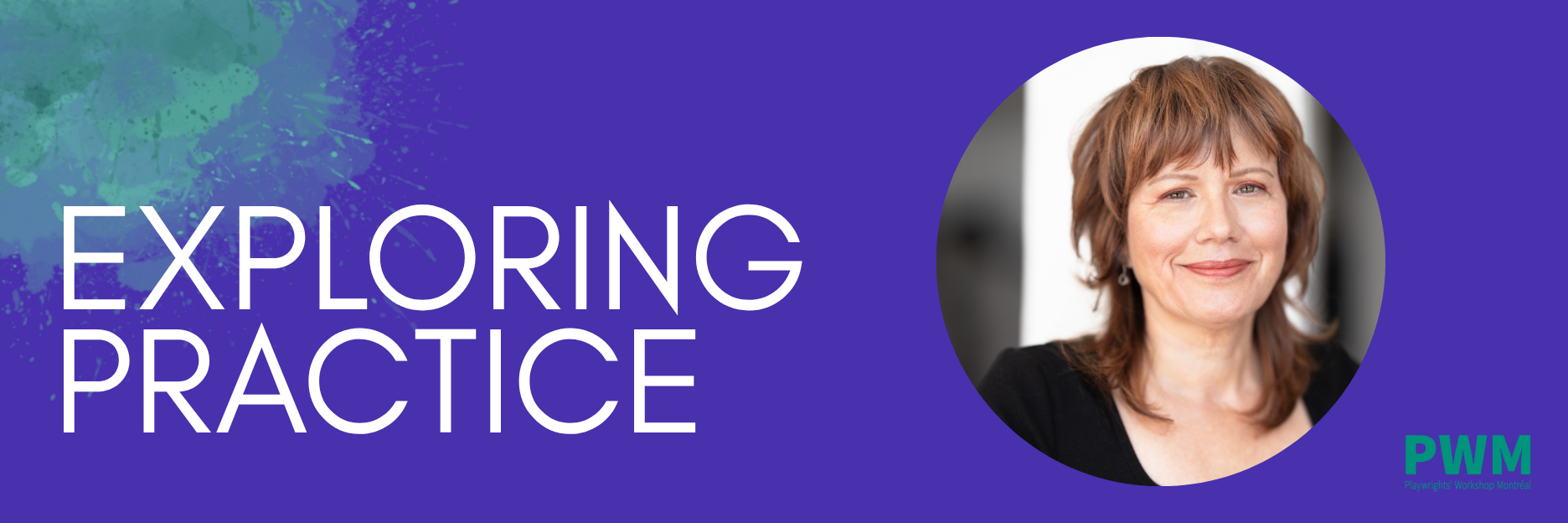
A blue background with a green paint splatter on the upper left side. Beneath, to the left, the words Exploring Practice in white. To the right, the headshot of the workshop facilitator, Emma Tibaldo.
Application Deadline: sunday, November 16TH, 2025 AT 11:59PM EST.

If you have any questions regarding accessibility, or require assistance with this application, please contact accessibility@playwrights.ca.

Have you always wanted to learn more about dramaturgy as an artistic practice or how to approach a process dramaturgically? In describing her Exploring Practice, Emma Tibaldo writes:

“There are as many dramaturgical processes as there are dramaturgs and playwrights. I will attempt to share some of the things I have learned in my 20-year career as Dramaturg, and Director of New Canadian Plays. This workshop is open to emerging dramaturgs and theatre artists curious about the collaborative dramaturgical process.

We will look at a variety of scenarios including:

How to begin a first conversation around the process with a playwright?

How to work with friends and colleagues?

How to gauge your own interest in a project? When to step away from a project?

How to work with directors and designers?

What does it mean to dramaturg a play and then transition into directing the production?

What is our responsibility to the theatre community we work in?

There will be practical group and individual exercises. You will be asked to share your own experiences in an effort to learn from one another and to identify some best practices we can then expand on in our own collaborations. 

We will end our time together with an open question session. You will have the opportunity to ask anything you like about Dramaturgy (and stuff related to theatre) to PWM Dramaturgs and myself.”


SCHEDULE

Monday, December 15, 2025: 10AM to 2PM

Tuesday, December 16, 2025: 10AM to 2PM

Wednesday, December 17, 2025: 10AM to 2PM

Thursday, December 18, 2025: 10AM to 2PM

Participants are expected to be available for the duration of the scheduled sessions.

LOCATION

PWM Studio: 7250 Rue Clark #103, Montreal, Quebec, H2R2Y3

Click here for accessibility information and video tours of our location.


HOW TO APPLY:

If you are interested in applying, please fill out this Google Form by 11:59 PM EST on Sunday, November 16, 2025.

Questions about this workshop can be sent to PWM’s Professional Development and Training Coordinator, Alexy Trottier, at alexy@playwrights.ca with the subject line: Exploring Practice with Emma Tibaldo.

If you have any questions regarding accessibility, or require assistance with this application, please contact accessibility@playwrights.ca.

Click here for accessibility information and video tours of our location.

PWM welcomes all applications. While recognizing that the identity of each person is fundamentally plural, and multidimensional, we strongly encourage applications from artists who are: Indigenous (First Nations, Métis, and Inuit), Black, POC, racialized (including recent immigrants), 2SLGBTQQIPAA+, neurodivergent, disabled, living with chronic illness and/or chronic pain. PWM is strongly committed to supporting a wide range of cultural identities and lived experiences, therefore we encourage applicants to self-identify in their application if they are comfortable doing so.


ABOUT THE WORKSHOP FACILITATOR:

Emma is presently Artist in Residence at Concordia University, a freelance Director and Dramaturg, faculty member of the Banff Arts Centre’s Playwrights Lab, and Associate Artist with Poverty Cove Theatre. She is the former AED of Playwrights’ Workshop Montreal where for fourteen years she dramaturgically collaborated on many new Canadian plays. Emma is an award winning director whose work has been presented across Canada. Most recently IDEMY by Elena Belyea, Still Life by Marie-Claude St-Laurent and Marie-Ève Milot, and Grace by Megan Gail Coles. She is a recipient of LMDA’s Elliott Hayes Award for Outstanding Achievement in Dramaturgy, and the Conseil Québécois du théâtre Prix Sentinelle. She is also a member of the interdisciplinary company, The Bakery. She co-founded Talisman Theatre fresh out of NTS. She feeds her inner punk rocker by playing in two basement bands.

Photo Credit: Bernardo Fernandez


LEARN MORE ABOUT EXPLORING PRACTICE WORKSHOPS


THIS WORKSHOP IS FINANCIALLY SUPPORTED BY

Announcing the 2025-2026 Introduction to Theatre Translation Participants

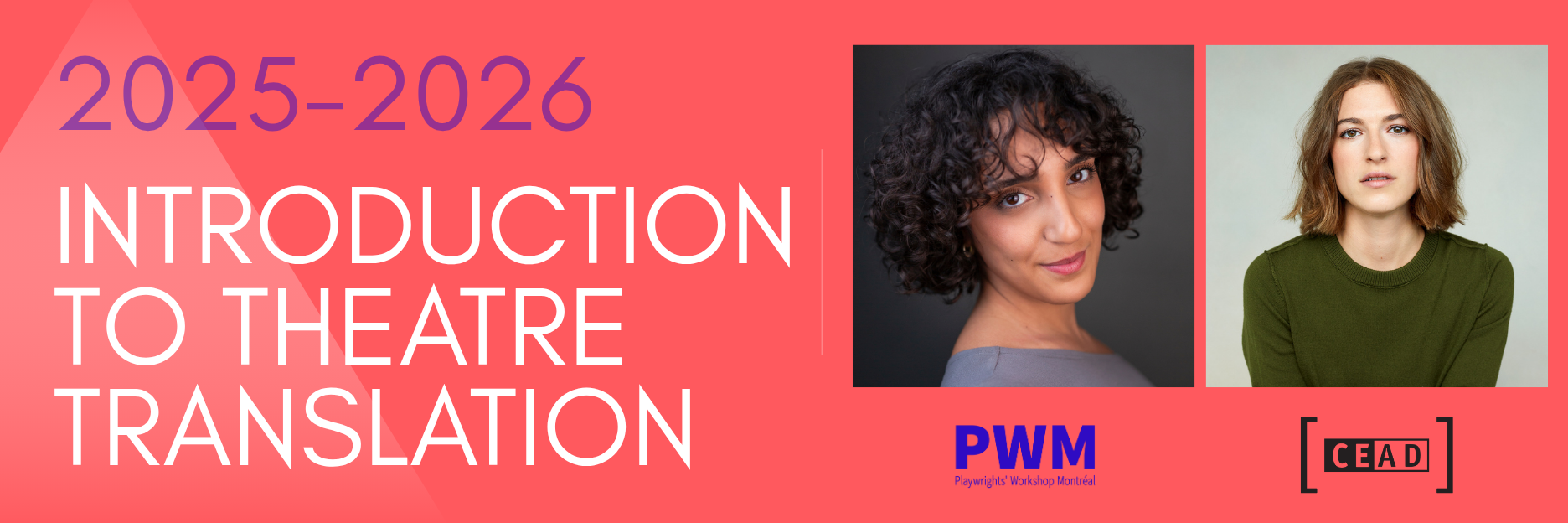
A red background with a white translucent pyramidal shape on the left hand side. On the top left, the years 2025-2026 written in purple. Beneath, the words Introduction to Theatre Translation written in white. To the right, the headshots of Lamia Karam and Camille Paré-Poirier. Beneath those, the logos for PWM and CEAD.

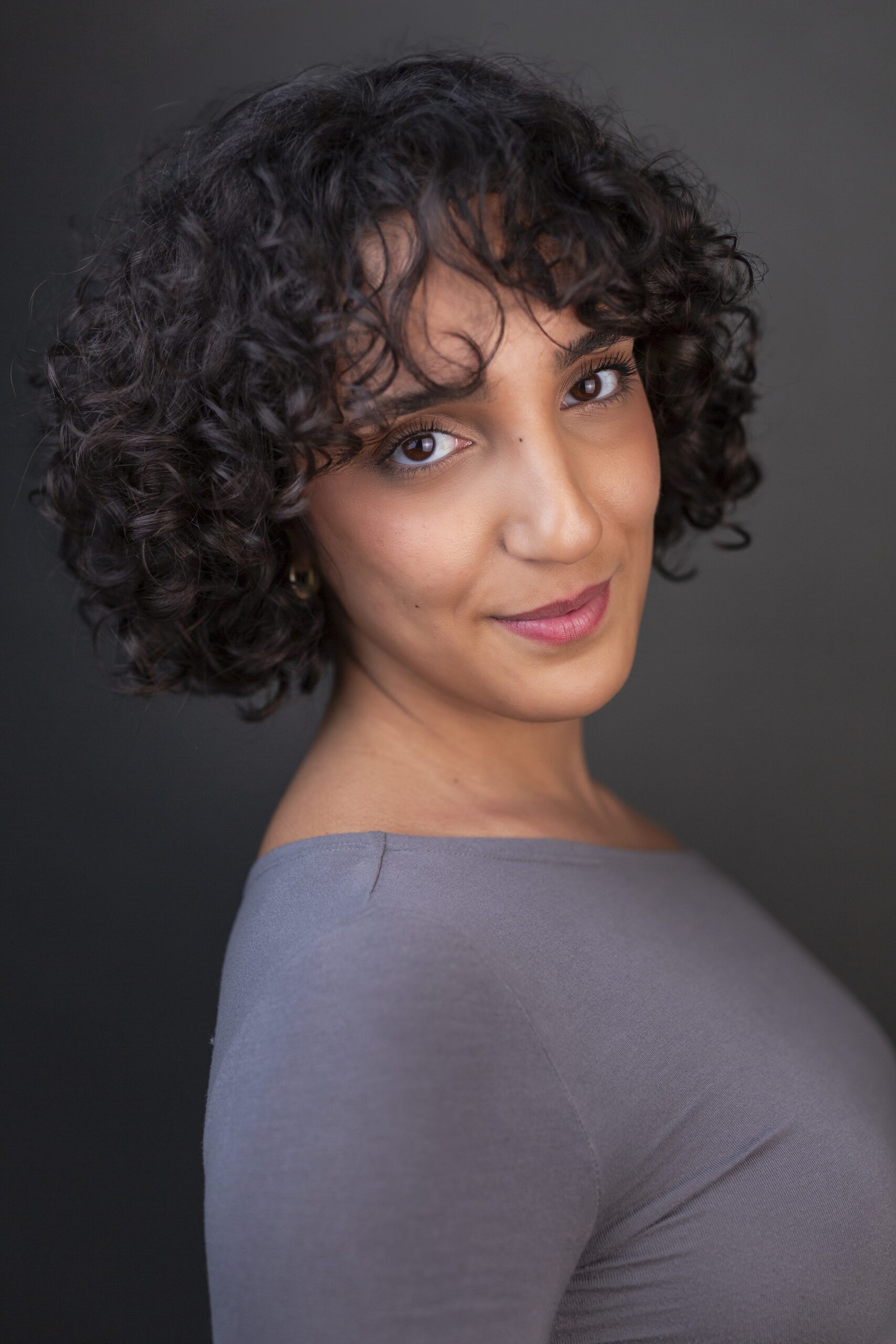
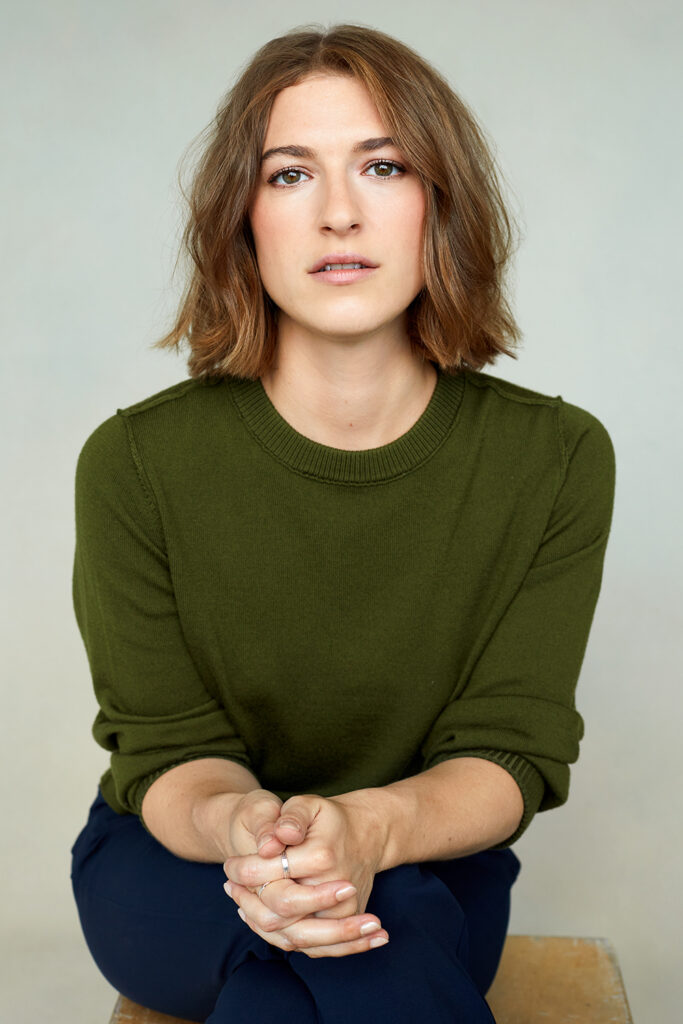
PLAYWRIGHTS’ WORKSHOP MONTRÉAL AND LE CENTRE DES AUTEURS DRAMATIQUES ARE THRILLED TO WELCOME LAMIA KARAM AND CAMILLE PARÉ-POIRIER AS PARTICIPANTS OF THE THIRD EDITION OF INTRODUCTION TO THEATRE TRANSLATION.

From September to March, Lamia and Camille will work with PWM and CEAD under the guidance of acclaimed playwrights and theatre translators Alexis Diamond and Mishka Lavigne. Lamia will translate two excerpts from contemporary Québécois plays from French to English. Camille will work closely with le CEAD to translate two excerpts from English to French. 

Each participant will receive 20 hours of translation mentorship over the course of the program. They will also have the opportunity to connect and discuss directly with the original playwrights to deepen their understanding of the texts. 

The mentorship will culminate in two workshops per excerpt, and a meeting of the full team  at the PWM Studio to share their work, discuss the process, and reflect on their learnings.

French to English Participant, Lamia Karam

Lamia Karam (she/her) is a trilingual actor and theatre artist based in Tiohtià:ke/Montreal and a recent graduate of Concordia University’s BFA in Acting for the Theatre. Raised as a third culture kid, she grew up moving between languages and cultures, a reality that continues to shape her artistic voice. Living between English, French, and Arabic has nurtured her curiosity about the ways language bridges, and sometimes defines our worlds. As a performer, Lamia is drawn to work that interrogates identity, culture, and selfhood. Collaboration and care are at the core of her process, and she strives to create spaces rooted in curiosity and connection. Her interest in theatre translation emerges from this same impulse: to bridge divides and make space for voices across linguistic and cultural lines.

Photo credit: Brooklyn Melnyk

English to French Participant, Camille Paré-Poirier

Camille Paré-Poirier est autrice et comédienne. Elle développe son écriture par le biais de l’autofiction, de l’approche documentaire et de la poésie. En 2021, elle publie Dis merci, un recueil de poésie narrative qui se retrouve dans la sélection du jury du Grand Prix du Livre de Montréal. Elle scénarise, coréalise et interprète le balado Quelqu’une d’immortelle, disponible sur Ohdio et La Fabrique culturelle de Télé-Québec. En 2023, elle adapte son balado pour la scène, sous forme d’un solo documentaire. Je viendrai moins souvent s’est mérité le Prix écriture dramatique de la saison 2022‑2023 du Centre du Théâtre d’Aujourd’hui, en plus d’être repris dans plusieurs salles à Montréal et ailleurs au Québec. Ancrés dans une démarche transdisciplinaire, ses différents projets l’amènent à aborder les concepts du « soin » et de la transmission au féminin. Depuis 2022, Camille est collaboratrice à l’émission Il restera toujours la culture, sur les ondes de Radio-Canada.

Photo credit: Julie Artacho


Lamia’s Mentor, Alexis Diamond

Headshot portrait of author Alexis Diamond

Alexis Diamond’s multidisciplinary practice encompasses theatre, installation-performance, opera, musical theatre, translation, curation and dramaturgy. Alexis was a finalist for the 2020 Governor General’s Award for her translation of Pascal Brullemans’ plays for young audiences, Amaryllis and Little Witch (Theatre Direct/Geordie Theatre/Playwrights Canada Press), and the 2021 Tom Hendry TYA Award for her translation of Érika Tremblay-Roy’s The Problem with Pink (Le Petit Théâtre de Sherbrooke/Lansman).

Alexis’ translation of Marie-Claude Verdier’s Seeker will premiere at the Centaur Theatre in spring 2026, in a co-production with Talisman theatre directed by Rebecca Gibian. Alexis has also translated award-winning plays by Audrey-Anne Bouchard & Marc-André Lapointe, Alexia Bürger, Virginie Daigle, François Grisé and Marie-Hélène Larose-Truchon, commissioned by Bouche Theatre Collective, DynamO Theatre, Infinitheatre, Théâtre Incliné and Un et un font mille.  Alexis has been the English-language translation mentor for Traductions Croisées since 2019. She has a B.A. Honours in English and Creative Writing from Concordia University and an M.A. in English Literature from the Université de Montréal. Many of her works can be found at the Canadian Play Outlet.

Photo credit: Ron Diamond

Camille’s Mentor, Mishka Lavigne

Autrice, scénariste et traductrice littéraire, ses textes ont été produits et développés au Canada, aux États-Unis, en Europe, en Australie, à Haïti et au Mexique. Elle était finaliste au prestigieux Prix Siminovitch en 2023. Son texte Havre, créé à la Troupe du Jour (Saskatoon), a remporté le Prix du Gouverneur Général en 2019. Copeaux, produit par le Théâtre de Dehors (Ottawa), a remporté ce même prix en 2021 en plus du Prix Jacques-Poirier. Murs, produit en format balado par Transistor Médias, Créations In Vivo et le Théâtre populaire d’Acadie, s’est attiré des honneurs en France et a été porté à la scène en 2023.

Mishka écrit aussi en anglais. Son texte Albumen, produit par TACTICS en 2019 (Ottawa), est récipiendaire du QWF Playwriting Prize ; de plus, on a récemment pu voir Shorelines (TACTICS) en 2023.

En tant que traductrice, autant vers le français que vers l’anglais, Mishka signe près d’une vingtaine de traductions de théâtre, de prose et de poésie.

Photo credit: Marianne Duval


This mentorship is presented in partnership with:


Les activités de la formation continue du CFC sont soutenues par le programme Intervention-Compétences et grâce à la participation financière du gouvernement du Québec.

With financial support from:

Accessibility Tools
English (Canada)
Skip to content