Applications for Dramaturgical Collaborations are now open.
APPLICATION DEADLINE: January 30th, 2024 11:59PM EST
All applicants will receive a response by the end of April 2024 informing them of the outcome of their application for the 2024-2025 season.
The ASL video format of this section is viewable here.
The open call for Dramaturgical Collaborations is PWM’s invitation to playwrights and creators from across Canada to work with us. Together, we engage in deep explorations of story, form and process.
Our Dramaturgical Collaborations begin with one-on-one and ongoing Dramaturgical Conversations in which we discuss the needs of the project and playwright/creator(s). From there, we mutually determine with the artist(s) one or a combination of the following opportunities for the project:
Workshops: An opportunity to explore a work in progress with actors/collaborators in order to evolve the project. Each Workshop is led by a PWM dramaturg in collaboration with the playwright/creator(s). Text based projects will be read by a company of actors and the playwright and dramaturg will then have the opportunity to ask and explore questions with the company. For non-text based projects, the Workshop is designed around whatever elements create the narrative/event. Sometimes a private reading for invited guests is a part of a Workshop, and it is used as an opportunity to introduce the work to an audience for the first time. The length of a Workshop is determined by the needs of the project.
Residencies: As part of the Dramaturgical Collaboration, PWM may offer dedicated Studio time for exploration (not rehearsal) to a playwright/creator(s) developing a project with PWM. These residencies take place in our studio in Montreal, and are separate from our national residencies at Gros Morne and Tadoussac.
Mentorships: Mentorships are set up to answer a very specific need in the early stages of a creation process. In collaboration with a PWM Dramaturg, the playwright/creator determines who is best suited to accompany them through this essential phase. This may be an expert in a given discipline, a creator from a similar or different discipline, or a dramaturg with a particular field of experience. The mentor is paid by PWM to work with the artist as a mentee.
To learn more about these and other terms used at PWM, please refer to our glossary.
Considerations for Dramaturgical Collaboration at PWM
The ASL video format of this section is viewable here.
Stage of Development: We accept applications for projects at all stages of development depending on the nature of the work. It could be an idea, a first draft (in whatever form that may be), a new iteration of a project that has already been shared, or a draft that is in an advanced stage of development.
Discipline: This project could be a play, a performance, a digital work (for example: AR/VR, interactive game-based presentation, live or prerecorded virtual performance), or something hybrid in terms of language, discipline, or technology.
Applicants: We welcome individual playwright/creator(s)and collectivesto apply directly through our Google form. If you are a theatre company, please contact dramaturg@playwrights.ca to discuss Dramaturgical Collaborations before submitting an application online.
Location: We welcomelocal and nationalapplications. We work in-person, virtually (for example: by video chat or by use of online collaborative tools), or a combination of both. *Please note that working virtually is an option available to out-of-town artists, as well as local artists based in Montreal.
Because developing plays and performances takes time, PWM has numerous ongoing projects. Therefore, we can only welcome a limited number of new projects per season despite receiving many inspiring applications. We are grateful to everyone who applies.
PWM is committed to creating an environment where all individuals are treated with dignity and respect. We are continuously working to make all of our programs accessible and inclusive. While recognizing that the identity of each person is fundamentally plural, and multidimensional, we strongly encourage applications from artists who are: Indigenous (First Nations, Métis, and Inuit), Black, POC, racialized (including recent immigrants), 2SLGBTQQIPAA+, d/Deaf, neurodivergent, disabled, living with chronic illness and/or chronic pain. PWM is strongly committed to supporting a wide range of cultural identities and lived experiences, therefore we encourage applicants to self-identify in their application if they are comfortable doing so.
How to apply for Dramaturgical Collaboration at PWM
The ASL video format of this section is viewable here.
You can apply for Dramaturgical Collaboration via our Google form, linked here. Audio and video answers to some of the questions in the form are also welcomed. Click here to preview the form as a PDF.
You will be asked to provide:
General information about you
Information about your project
How you would like to work with PWM
Your CV and bio and that of any collaborators
A sample of the proposed project (if available) or past work
Your proposal will not be sent until you click the SUBMIT button at the end of the application via the Google form. You will be able to edit your responses until the application’s deadline by reusing the same email address and login.
If you have any questions regarding Dramaturgical Collaborations, please contact us at dramaturg@playwrights.ca
If you have any questions regarding accessibility, require assistance with your application, or would like to discuss alternative methods of applying and deadline flexibility, please contact accessibility@playwrights.ca. For accessibility information and video tours of our location, please click here.
This program offers sustained dramaturgical and artistic support to one working playwright* residing on the island of Montréal. This includes dramaturgical consultation, a creation workshop, a creation production residency, followed by a laboratory presentation.
The program aims to support the artistic practice of theatre artists who identify as Indigenous (First Nations, Métis, and Inuit), Black, POC, racialized including 1st or 2nd generation immigrant artists (as defined in the Conseil des Arts de Montréal’s glossary) working creatively in one of Canada’s official languages. Additionally, it seeks to foster dialogue between Montréal’s English- and French-speaking theatre communities, as well as intercultural exchanges and greater representation for culturally diverse artists within the theatre community and on Montréal’s stages.
In order to support artists writing in French and artists writing in English, CAM and La Serre offer this program alternately with the Centre des auteurs dramatiques (CEAD) in French, and with PWM in English. This edition is intended for artists creating in the English language. PWM is an English language minority company, therefore the work with PWM will take place in English and the application must be completed in English. Please refer to the Program Presentation (PDF) for more details about what this partnership includes, eligibility criteria and other conditions. Board Members of CAM, PWM and La Serre are not eligible to apply.
* This is an opportunity for professional playwrights as defined in the Conseil de Arts de Montreal glossary: “An individual with a professional artistic practice who possesses the necessary experience and knowledge to develop this practice. This includes self-taught individuals as well as those who have studied art. This person is recognized in their artistic community (artists working in the same artistic tradition), creates, carries out or publishes works of art, is dedicated to their artistic practice and is generally paid for their work.”
THE SUPPORTING ORGANIZATIONS
CONSEIL DES ARTS DE MONTRÉAL
Founded in 1956, the Conseil des arts de Montréal identifies, supports and recognizes excellence in the professional creation, production and dissemination of the arts.
To remain in tune with the organizations and collectives it serves, the Conseil relies on its knowledge of the communities, its innovative skills, and its ability to bring the city’s artists and financial partners together.
PLAYWRIGHTS’ WORKSHOP MONTRÉAL
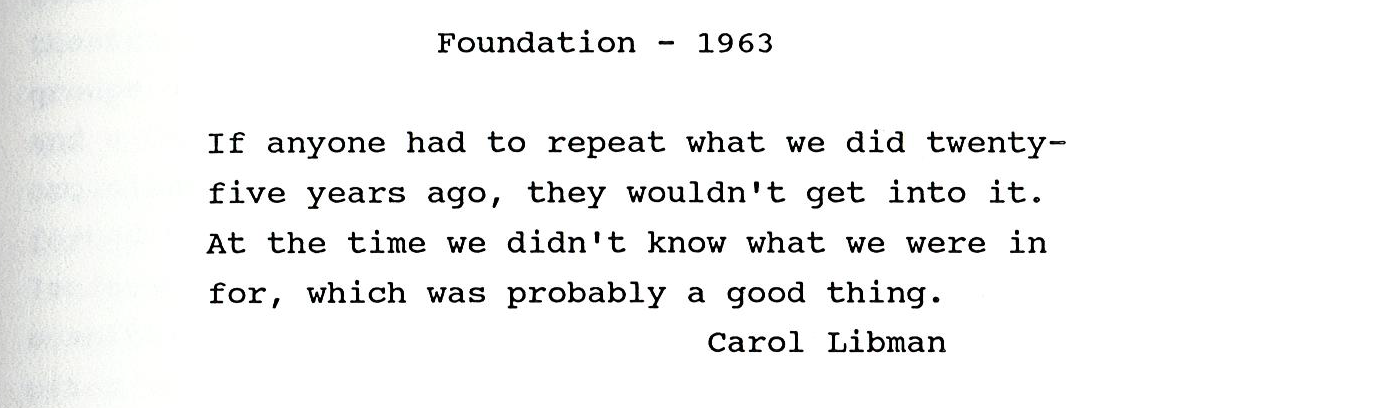
Founded in 1963, Playwrights’ Workshop Montréal (PWM) is a nationally-mandated theatre creation and development centre based in Montréal. PWM is led by a team of experienced dramaturgs and arts administrators. With a focus on dramaturgy, its mission is to collaborate with artists in the development of new works of theatre and performance. PWM gives artists the opportunity to create and experiment, dream and take risks. Its collaborative process draws on the team’s unique experience and is tailored to the artist’s individual needs.
At PWM, playwrights, dramaturgs, translators, directors, performance makers, and theatre companies across the country find a creative accomplice willing to invest deeply in the development of meaningful work. Through PWM’s programming and activities, individual artists and companies meet and make new connections. By fostering these artistic connections, PWM acts as a community hub for theatre-makers in Montreal and beyond.
PWM has a deep commitment to equity, diversity, and inclusion. PWM’s staff have read and reviewed the progress of the 94 calls to action from the Truth and Reconciliation Commission of Canada as well as the UNDRIP, and are committed to working towards adapting recommendations into the organization and its programming. PWM regularly partners with Indigenous (First Nations, Métis, and Inuit), Black, POC, racialized (including recent immigrants), 2SLGBTQQIPAA+, neurodivergent, and disabled artists and organizations as well as artists living with chronic illness and/or chronic pain in its programming while continuing to work to deepen its practices and address systemic issues throughout the organization.
PWM operates a 2,000 square foot creation studio and shared office space, equipped with theatre lighting, sound and digital equipment. Click here for accessibility information for our office and creative studio space: https://www.playwrights.ca/accessibility-contact/
LA SERRE – ARTS VIVANTS
LA SERRE is a structuring incubator for the improvement of the conditions under which emerging artists carry out their work in live art. It accompanies them in the expansion of their work, from the creation process to encounters with the public. It helps artists develop their autonomy, organizational maturity and artistic independence. LA SERRE acts as an activator of collaborations between artists and local, national and international partners, as well as artists from various artistic disciplines and other areas. Artistically, LA SERRE favors projects that establish evocative links between art and society, and facilitate connections between different disciplinary fields and sectors.
SUPPORT PROVIDED
The recipient of the program will receive a project creation grant of $13,000 from the CAM over two years, along with numerous services provided by PWM, LA SERRE, and CAM. This is a one-time, non-renewable grant.
The program takes place over two years, and support is provided as follows:
YEAR 1
$3,000 creation grant for a new theatrical creation
30 hours of dramaturgical collaboration with Playwrights’ Workshop Montréal
9 hours of script workshopping offered by Playwrights’ Workshop Montréal
A staged reading with actors at Playwrights’ Workshop Montréal
YEAR 2
$10,000 creation grant for production
50 hours of production and management mentorship by LA SERRE–arts vivants
60 hours of free access to the Conseil des Arts de Montréal’s studios
Presentation of two performances in lab format
One-year subscription to Machinerie des arts.
APPLICATION PROCESS
To apply, please complete the online application form. Refer to the Program Presentation (PDF) for all details about this partnership. During the application process, you will be asked to include the following documents in PDF format:
An excerpt of a previously written theatrical work in English (10 pages maximum);
An excerpt of the project (10 pages maximum);
A CV
Only the required documents will be forwarded to members of the evaluation committee.
Applications will be evaluated by representatives of the CAM, PWM and La Serre. Projects will be evaluated based on merit, feasibility, and impact on the artist.
PWM is strongly committed to supporting a wide range of cultural identities and lived experiences. We strongly encourage eligible applicants who also identify as 2SLGBTQQIPAA+, d/Deaf, neurodivergent, disabled, living with chronic illness and/or chronic pain to self-identify in their application if they are comfortable doing so.
The deadline to submit applications is October 27, 2022 at 11:59PM.
ADDITIONAL INFORMATION
If you have any questions about the eligibility of your application or your project, or the program in general, do not hesitate to contact us.
Please address questions to Fatma Sarah Elkashef, Artistic Director of Playwrights’ Workshop Montréal, at sarah@playwrights.ca. If you have any questions regarding accessibility, or require assistance with this application, please contact Heather at accessibility@playwrights.ca.
YCU NEWS: WE’RE welcoming a new dramaturG to lead the Unit
Playwrights’ Workshop Montréal is delighted to announce that dramaturg and director Leila Ghaemi will be leading this year’s Young Creators Unit! The current leader and creator of the YCU, Jesse Stong, will work with YCU alumni this year, while continuing their work as a dramaturg at PWM with both the Queer Reading Series and the New Stories Project.
“I’m so excited to have Leila taking the Young Creators Unit into the next phase. With her passion, intelligence, and experience, I am sure she will exceed expectations!” says long-time YCU facilitator Jesse Stong.
The application period for this year’s YCU has now passed. We’d like to thank each of the creatives who applied.
If you’re an aspiring playwright or storyteller who is 30 or under, then Playwrights’ Workshop Montréal’s Young Creators Unit (YCU) is the place to grow your work. This incubator for learning and experimentation helps emerging artists find their voice, as they workshop an original piece of theatre over the course of several months.
Playwriting is an ever-expanding field, and workshop environments are flexible and judgment-free spaces to work collectively. Interested storytellers need only apply with an idea, a question, a theme or topic. We welcome diversity of experience in life and in theatre, and all kinds of emerging writers and theatre makers are encouraged to apply.
By taking part in group sessions every two weeks, participants establish their craft in conversation with a close cohort of creatives. A customized work plan and one-on-one mentorship supports the development of your play, alongside professional support with grant writing and networking opportunities.
PWM welcomes all applications to our programs. While recognizing that the identity of each person is fundamentally plural and multidimensional, we strongly encourage applications from artists who are: Indigenous (First Nations, Métis, and Inuit), Black, POC, racialized (including recent immigrants), 2SLGBTQQIPAA+, neurodivergent, disabled, living with chronic illness and/or chronic pain. PWM is strongly committed to supporting a wide range of cultural identities and lived experiences, therefore we encourage applicants to self-identify in their application if they are comfortable doing so.
To learn about what it’s like navigating our space click here.
how to apply
Fill out this Google Form by 11:59 PM onSeptember 27, 2022. Your application will require the following information:
A brief bio of yourself, and your experience (if any) as a storyteller/creator.
A brief description of the work you would like to develop, or a list of some ideas.
A brief description sharing why you would like to join the Unit, and what you hope to get out of the experience.
Group sessions will take place in person every 2 weeks on Tuesdays from 5PM-8PM, and will shift to a weekly format beginning in January 2023. The program runs from October 18th, 2022 to May 26th, 2023 in PWM’s studio at 7250 Rue Clark in Montreal.
There are limited spots in the program and participants are expected to attend the group sessions, one-on-one meetings, as well as commit to some additional self-directed activities. Please only apply to the Unit if you can commit to the schedule. All applicants will be informed of their results by October 12.
PWM is committed to upholding safety and comfort for in-person gatherings, with regard to COVID-19. We continue to strongly encourage the regular wearing of masks, frequent hand-washing and use of sanitizer, as well as frequent surface wipe-downs. To read more about PWM’s COVID-19 guidelines, click here.
THE SELECTION PROCESS
A selection committee will be reading all applications and selecting the participants for the Unit. There are many factors that go into the selection process in addition to the consideration of your application, such as group dynamics and the range of experience within the cohort. There are no judgements with regard to training or competencies.
Anne-Sophie Grenier is a performer, writer, curator, and arts administrator. She is excited to be returning to her home town of Montreal after having served as the Executive Director of Modern Fuel Artist-Run Centre in Kingston, Ontario for the past 3.5 years. Her career has also included documentary film production, festival management, and international development. Anne-Sophie holds a Masters of International Arts Management from HEC Montreal and Southern Methodist University, as well as a B.A., Communications Studies from Concordia University. She is passionate about creating innovative opportunities for artists at the local, national and international level and is very much looking forward to collaborating with fellow creators in Montreal’s vibrant theatre community.
Anne-Sophie is appointed to the position following the departure of former Managing Director Lesley Bramhill, who was an integral part of the PWM team for five and a half years. Given Anne-Sophie’s education in arts management, leadership experience, and her artistic practice we are excited for the impact she will make at the organization and in the Montréal theatre community at large.
“We couldn’t be more pleased with the choice of Anne-Sophie Grenier as our new Managing Director at Playwrights Workshop Montréal. Building on her experience as Executive Director at Modern Fuel, she has a solid, strategic understanding of the interrelations between operations, finances and core activities. Anne-Sophie brings a wealth of management experience as well as a passion for creating supportive spaces for artists. She demonstrates a strong commitment to applying approaches to equity, diversity, inclusion, accessibility and decolonization. We look forward to witnessing what promises to be a strong and stimulating co-leadership between Anne-Sophie and Sarah.”
– Naïma Kristel Phillips, President of the Board of Directors at PWM
Last year, in collaboration with Arts Consulting Group, we shifted our organizational structure to better support our internal leadership and honour our spirit of collaboration. The new structure of our organization supports a co-leadership between the Artistic and Managing Directors.
“I am thrilled to welcome Anne-Sophie to the team and look forward to co-leading PWM with her. Anne-Sophie is experienced in collaborative leadership and arts management and is dedicated to supporting artists- I’m excited for us to meet the future together!”
After a year of transitions and adaptations to the pandemic context, we look hopefully to the future of our organization under the new co-leadership team of Sarah and Anne-Sophie. This new chapter will yield fruitful collaborations and creative processes that we are excited to realize!
“I am honored by the trust that the Board and hiring committee have placed in me to be the new Managing Director in co-leadership with Sarah. Most recently, I was working in the visual arts while maintaining my own writing and acting practice; theatre has been my greatest love and truest friend, and I am happy to be able to bring my experience and passion to the role of Managing Director. I am excited about collaborating with the wonderful team here and the larger Montreal theatre community, putting my managerial and leadership experience towards supporting the important work done by everyone involved with PWM.”
Over the past several years, Playwrights’ Workshop Montréal (PWM) has been researching ways to create more accessible and inclusive spaces. In 2019, we hired Kéroul to conduct an accessibility audit of our physical spaces, and they gave PWM a report with many recommendations. As tenants in the building, we have been limited in what changes we can make to the physical spaces, and so we shifted our focus to areas where we have more immediate agency to make changes: digital and cultural accessibility. In 2020-2021, PWM worked with Accessibility and Inclusion Consultant Clary Chambers to find tools, resources and approaches to creating more inclusive and accessible digital and cultural spaces. As Vice President of PWM’s Board of Directors, Corrina Hodgson, describes in the article below, in the winter and spring of 2021 we invited six D/deaf and disabled artists from the community to speak with us about how PWM could become more accessible and more inclusive.
FINDING THE LOVE: PWM’S ACCESSIBILITY COMMITTEE 2020-2021
By Corrina Hodgson
CHALLENGING ACCESSIBILITY AUDITS
Like many theatre organizations in Montréal, PWM is located in an inaccessible building that it leases. Unsurprisingly, it scored low on an accessibility audit executed two years ago.
While the results of the audit were factually correct, they did not sit right with me. I am a disabled playwright and I have served as an artist member on PWM’s Board of Directors for the past four years. The audit did not capture the culture of the organization that I know.
Enter Clary Chambers.
We decided to move beyond an accessibility audit and expand our definition of accessibility to include Cultural and Digital Accessibility. This definition of accessibility came from a workshop that I’d attended in 2019 by Spark Clarity run by Clary Chambers. PWM hired Clary Chambers to train staff members and assist me with the first meeting of the Accessibility Committee.
One core learning acquired from Clary this time around was the idea that accessibility begins at the point of contact. It’s not enough to have an accessible space or event. We must make our communications accessible. This impacted how we communicated with the members of the Accessibility Committee about our meetings. Every email included an ASL video, and a separate spoken video with closed captions. This allowed our emails to be read, listened to, listened to and read at the same time, or watched. Beyond communicating the content of the email, this approach communicated that everyone’s welcome and that everyone’s accessibility needs are valid.
THE MEETINGS
“ . . . [W]e are not struggling because there’s something wrong with us; we are struggling because the systems that were set in place were for a specific group of people, and they’ve never been changed.” — Clary Chambers
For six meetings over six months — 12 hours total — artists Cherie Pyne, Violette Kay, Willow Cioppa, Penina Simon, Sage Lovell, Lois Brown, and I (Corrie Hodgson) — met with PWM staff in attendance, including staff participant Heather Eaton to discuss all things accessibility and how disability, chronic pain, and chronic illness impacts our life and art, both before and during COVID (acknowledging that post-COVID has yet to exist.) We spoke of our interactions with PWM, discussed how PWM could be an ally, and future dreamed.
PWM and I urged participants to inform us of any accommodations that would make meetings more accessible for them prior to or during meetings. This seems simple, but isn’t. As one participant pointed out, we don’t always know what we need, we just know this isn’t it. And another one said that we’re so used to being asked for what we need, but not for what makes things easier — and that’s a big difference.
Some accommodations we made were that we had ASL-English interpreters and encouraged everyone to make use of chat features. Speakers identified themselves prior to speaking. Participants were welcome to turn cameras off or keep them off for the entire meeting if that felt right. They were welcome to fidget, stand up and stretch, or attend while lying in bed. Nothing was interpreted as disinterest or “unprofessional.” Instead, we welcomed all bodies in all states of being, and all modes of communication were treated equally.
This approach to meetings sent the message that you do not have to fit yourself to the meeting. Instead, the meetings were made to fit our participants. Their form was malleable so that the humans didn’t have to be.
This malleability of structure is something the committee agreed was a shared value as disabled artists. Many of the group members wondered if PWM could extend this flexible approach to other aspects of its work. For example, could PWM livestream their events for those of us who are physically incapacitated but would like to attend? Could PWM’s programs be made accessible remotely? And, of course, the ultimate malleability extends to deadlines. Many of us are writing on *Crip Time and therefore require flexibility with deadlines. In a field that defines “professionalism” as meeting deadlines (among other things), could PWM become a leader in challenging this definition and explore flexible deadlines with disabled playwrights? Could they fight for longer development time for the creation of new works? As Violette Kay pointed out, we just watched extensions be handed out universally and no one had to ask, so why do we think it’s so impossible to grant them to individual artists?
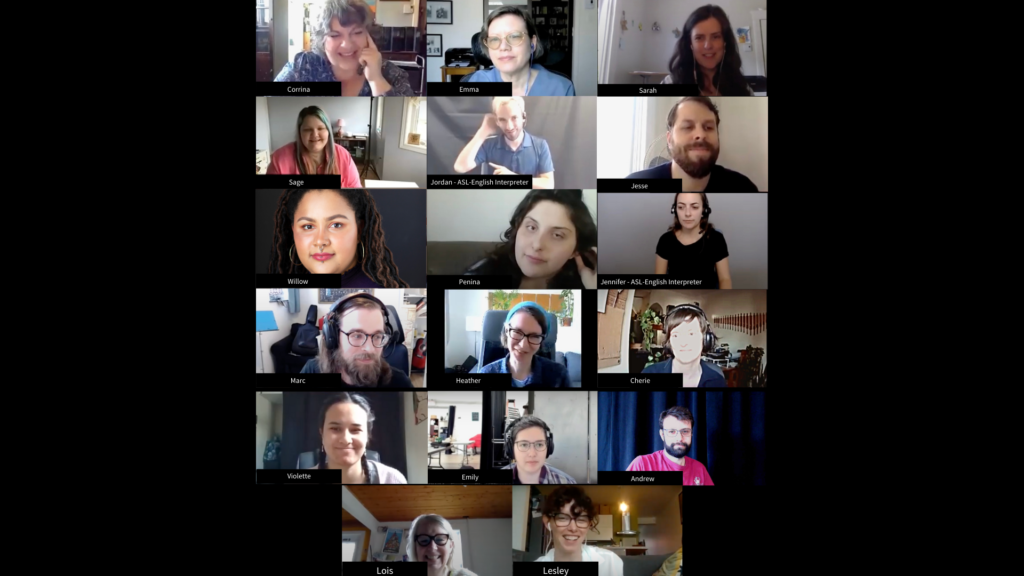
A zoom screen shot of one of the accessibility meetings featuring (left to right, top to bottom): Corrina Hodgson, Emma Tibaldo, Fatma Sarah Elkashef, Sage Lovell, Jordan (ASL-English Interpreter), Jesse Stong, Willow Cioppa, Penina Simon, Jennifer (ASL-English interpreter), Marc Duez, Heather Eaton, Cherie Pyne, Violette Kay, Emily Soussana, Andrew Scriver, Lois Brown and Lesley Bramhill.
HOW COVID IMPACTED OUR ART
A common experience amongst participants was a surge in survival employment during the pandemic. While most of our peers suffered financial losses, many of us were busier than ever. After all, we are a population that lives in quasi-lockdown without a pandemic, so the businesses we have developed — from music lessons and podcasting to consulting and technical writing — are well suited to COVID circumstances.
While suddenly earning more than ever before, and doing so in a time when many were struggling, was fortunate, it came at the expense of our creativity. Many of us felt obligated to take on as much paid work as possible, knowing that when the pandemic was over, we would once again be relegated to the sidelines and our earnings would return to pre-pandemic levels. The result amongst members was a sense of pushing past limits and not having anything left to give to creative projects. And there was a mounting guilt and panic about those projects, some of which had deadlines looming and dramaturges waiting for new drafts.
Sage Lovell spoke about how COVID had reduced opportunities for Deaf artists while accessibility measures increased options for Deaf spectators. This led to questions of how PWM could attract and support Deaf creators. Sage also reminded us of the very real fatigue brought on by digital spaces — something that everyone has experienced by this point in the pandemic.
Our sense of being overwhelmed by our side gigs and day jobs happened right when we were the most disconnected from our creative communities. We didn’t get to finish work and head to the theatre to gather in person with colleagues for a reading or show. We no longer had informal hang outs in local cafés to drink coffee and write. Many members longed for some sort of casual, drop-in group on a digital platform where we could congregate and support one another while writing. Again, flexibility in this vision played a key role, so that writers could come and go as needed.
Moreover, many of us live in small abodes. Penina Simon bemoaned the loss of her beloved cafés as that’s where she was used to writing. Similarly, Willow Cioppa spoke to the difficulty of working, eating, doing therapy and then trying to be creative all at the same table in their apartment.
POST-PANDEMIC ACCESSIBILITY
For many of us, defining a post-pandemic world is difficult. We struggle to imagine a time of safety after these past two years. Merely imagining physical interactions with friends — never mind strangers — induces anxiety. Willow Cioppa foregrounded the important role that consent will play in our post-pandemic world, as we will all be at different comfort levels with physical touch, with hugs, and it will all have to be negotiated.
When committee members were asked if they felt safe attending PWM as an artist or spectator in the future, we all agreed that we did. We know that PWM as an organization is thorough and careful, that safety measures will be followed.
But then someone raised the question of how would we get to PWM? How many of us felt safe on the metro? On busses? Not one of us.
And Violette Kay raised a larger, more important question, addressing in-person endurance. The thought of entering an in-person five-day workshop seemed, well, exhausting.
It’s not just a question of if we feel safe.
It’s a question of if we are ready.
Or maybe when.
And what we do until then.
PWM has striven to be a safe space and creative hub prior to and during the pandemic. We would love to see it maintain a digital presence both during and after the pandemic. That presence would bring safety and creativity to its community on a consistent basis. While we have been overwhelmed and lacking in focus throughout the pandemic, we have fought and continue to fight to maintain an artistic practice. Knowing that we can rely on PWM to remind us that we are artists first, that our art matters, and that our voices have important things to say brings a lived experience to the slogan “Access is Love.”
*Crip Time is explained by Alison Kafer in her book, Feminist, Queer, Crip as “Rather than bend disabled bodies and minds to meet the clock, crip time bends the clock to meet disabled bodies and minds.”
ABOUT CORRINA HODGSON
Corrina (she/her) is a Queer and disabled playwright and dramaturg with a passion for nontraditional story structure. Raised in Toronto, Corrina had the good fortune of being on writing units at Buddies in Bad Times Theatre and Nightwood Theatre before obtaining her MFA in Creative Writing at UBC. She has been playwright in residence at the University of Lethbridge and her work has been produced across Canada and in the US, as well as on CBC Radio One. She is the co-creator and Artistic Producer of The Rose Festival, Montreal’s multidisciplinary festival for Queer Creators.
OUR COMMITMENTS
Below is a list of actions PWM has taken since the Accessibility Committee conversations, as well as actions we are committed to taking in the coming year and beyond. These actions are informed by multiple sources, including those already mentioned, as well as PWM’s staff and board. We are learning more each week, and welcome feedback from community members so that we may continue to render our practices and spaces increasingly inclusive. To ask questions or offer feedback, please email: accessibility@playwrights.ca
We acknowledge that PWM is evolving as a company, our dramaturgical thinking is dynamic, and we commit to the actions below being dynamic as well.
Topic
Action
Timeline
Communications
Include videos of how to get to PWM’s location and how to get to our office/studio once inside the building
completed
Communications
Offer content advisories for live events, and contact person and their contact information to reach out to for more information
ongoing
Communications
Examine user experience to make accessibility information very easy to find on PWM’s website
ongoing
Communications
Add alt-text & image descriptions to the website and all social media
ongoing
Communications
Use a maximum of 5 words of text in all graphics
ongoing
Communications
Offer general and technical guidance and assistance for applications to PWM programs/job openings
ongoing
Communications
Situate accessibility information and access needs requests at the top of blog articles or event pages on the website
ongoing
Communications
Add a video tutorial to our Accessibility webpage on how to use the accessibility features on PWM’s website
completed
Communications
Add captioned video invitations to events and programming communications
Offer diverse modes of communication for applications at PWM
ongoing
Communications
Use a relay service for telephone communications
ongoing
Programming
Provide support to artists as they adapt to digital and hybrid mediums of creation and dissemination through Digital Dramaturgy Clinics
completed, ongoing
Programming
Check-in with artists about comfort, safety and preferred work conditions during the process of organizing development workshops
completed, ongoing
Programming
Add drop-in hours to the remote Writers’ Room to accommodate different scheduling needs
completed, and on hiatus
Programming
Communicate about the Writers’ Room through email and a shared Google calendar rather than Facebook
completed, and on hiatus
Programming
Hire an artist with lived experience with disability/chronic pain to co-facilitate the Writers’ Room
completed, and on hiatus
Programming
Hire and collaborate with artists from the d/Deaf community on their artistic projects
ongoing
Programming
Send tech gear to artists that need it for participation in programming
completed, ongoing
Programming
Offer hybrid, in-person and remote workshops
completed, ongoing
Programming
Offer technical orientation workshops and/or video tutorials for different digital platforms for artists prior to activities
ongoing
Public Events
Implement and communicate about accessibility for events
ongoing
Public Events
Publicize PWM’s current practices and structures in place for events
in progress
Public Events
Designate a PWM staff member as an Accessibility Liaision, available to respond to questions and requests
completed
Public Events
Hire ASL-English interpreters for live readings
ongoing to the best of our ability
Public Events
Project script during public events
ongoing on a case-by-case basis
Public Events
Offer livestream options for public events
ongoing on a case-by-case basis
Staff Training
Two PWM staff members begin learning ASL
ongoing
Staff Training
Begin staff training on working with neurodiverse artists, welcoming d/Deaf, disabled and/or neurodiverse members of the public to cultural spaces
in 2023
Working with Stakeholders
Include accessibility support requests in all funding request budgets
in progress
Working with Stakeholders
Continue to advocate to funding bodies for more support and longer and more flexible creation & development time in new theatre creation
ongoing
Working with Stakeholders
Work with property management to install non-slip and contrasting colour bands on the stairs inside the entrance of the building
Pursued and rejected by current property management
Working with Stakeholders
Work with property management to apply to the City of Montreal for a reserved parking spot directly in front of the building entrance at 7250 Clark
Partially complete: After discussions with the city, PWM was informed that permanent accessible parking spots for the building cannot be approved. However, in response to our advocacy, two parking spaces directly in front of the building will be designated as 2-hour parking starting in September 2024. This will accommodate drop-offs and short-term parking for artists with reduced mobility.
It is with gratitude for her dedication to our community that the Board of Directors announces Lesley Bramhill’s departure from her position as the Managing Director of Playwrights’ Workshop Montréal.
“The announcement of Lesley’s departure leaves us with many emotions: the sadness to see her go, the gratitude for her continuous work at PWM and commitment to the arts, as much as the excitement for her as she starts a new amazing opportunity.” – Tiffanie Guffroy, Treasurer of PWM
Lesley stepped into the role of General Manager with PWM in 2016. Collaborating with former Executive and Artistic Director Emma Tibaldo, Lesley impacted PWM’s sphere greatly. Her accomplishments include helping to move the organization into its location at 7250 Clark, helping to double the organization’s operating budget, and collaborating on expanding PWM’s programming and operations. She also collaborated with her colleagues in arts advocacy in Quebec and Montreal to help advance the English language arts sector. In 2019, she was awarded the Unsung Hero of the Theatre award at the META’s, specifically for this work.
“Thank you. Over the last five and a half years, I have learned so much from PWM’s staff, board, artists and community. I am really excited for my next adventure, and will miss all of you dearly.
It has been an honour to help grow PWM to where it is today, and I am proud of the new co-leadership model I am leaving behind. I know the organization’s future is strong, with our current board, staff and Sarah’s leadership in place. ”
-Lesley Bramhill
In 2021, after five years as the General Manager at Playwrights’ Workshop Montréal, Lesley was appointed Managing Director, creating the first co-leadership team with Artistic Director Fatma Sarah Elkashef. On Lesley’s time at PWM, Sarah notes that:
“Lesley’s work has helped transform PWM in profound ways over the past 5.5 years. I am sad to see my co-leader go but very grateful to her and the Board for creating this new dynamic structure for PWM. Lesley’s positive impact will be felt for a long time to come. We will miss you and wish you all good things, Lesley!” -Fatma Sarah Elkashef, Artistic Director of PWM.
Lesley’s presence, leadership, and passion will be deeply missed by her colleagues, our Board of Directors, and the Montréal theatre community as a whole. We would like to extend the warmest thank you to Lesley for her role in advancing artistic practice at PWM.
Lesley’s last day at PWM is on February 18, 2022. Our team and board are already working towards the recruitment of a new Managing Director, who will work alongside Fatma Sarah Elkashef. We are confident that this new chapter for PWM will be fruitful and are excited for the artistic collaborations and creations to come.
To provide the best experiences, we use technologies like cookies to store and/or access device information. Consenting to these technologies will allow us to process data such as browsing behaviour or unique IDs on this site. Not consenting or withdrawing consent, may adversely affect certain features and functions.
Functional
Always active
The technical storage or access is strictly necessary for the legitimate purpose of enabling the use of a specific service explicitly requested by the subscriber or user, or for the sole purpose of carrying out the transmission of a communication over an electronic communications network.
Preferences
The technical storage or access is necessary for the legitimate purpose of storing preferences that are not requested by the subscriber or user.
Statistics
The technical storage or access that is used exclusively for statistical purposes.The technical storage or access that is used exclusively for anonymous statistical purposes. Without a subpoena, voluntary compliance on the part of your Internet Service Provider, or additional records from a third party, information stored or retrieved for this purpose alone cannot usually be used to identify you.
Marketing
The technical storage or access is required to create user profiles to send advertising, or to track the user on a website or across several websites for similar marketing purposes.
Nick’s plays, radio plays (CBC), short stories and librettos have been presented across Canada, the US, Britain and Germany. Recently a member of PWM’s Cross Cultural Adaptation Lab, he is developing a new work inspired by the Catalonian liturgical drama, El Misteri d’Elx. His play Arco took 2nd place in Infinitheatre’s 2021 Write-on-Q Competition. Nick wrote the screenplay to the film Maz (Rendez-vous Québec Cinéma, 2018). His play Stained Glass won the Canadian Peace Play Competition in 2008 and was shortlisted for the Prism International Residency Award (2003). He is an alumnus of Tapestry Opera’s Lib Lab, the Banff Playwrights Lab, Theatre Centre Residency and Writers’ Units at NAC/GCTC and Playwrights’ Workshop Montréal.
Nick teaches and coaches at the National Theatre School of Canada. As a dramaturg and mentor, he has worked with PWM (Playwrights’ Workshop Montréal), NACO (National Arts Centre Orchestra), JMC (Jeunesses Musicales Canada) and currently, with Teesri Duniya’s 2025/26 Fireworks program.
Nick has been nominated for two METAs (Montreal English Theatre Awards) for his work as a Musician and Supporting Actor.As a composer, arranger and musician for the stage, Nick has worked and collaborated with the National Arts Centre; National Theatre School of Canada; Centaur Theatre; Great Canadian Theatre Company; Lucion Media; TF1 Rock’n’Roll Circus; Repercussion Theatre; Geordie Theatre; Imago Theatre; Infinitheatre; Skeels Danse Montréal; The Theatre Centre; Hudson Village Theatre, Theatre Lac Brome; CAM en tournée; Concordia University; National Circus School; McGill and Ottawa Universities; the METAs (Montreal English Theatre Awards); Third Wall; Théâtre Urbi et Orbi (Urban Tales); Monastère Cabaret de Cirque; and on Festival productions or concerts for Magnetic North, SummerWorks, Undercurrents, WildSide, Tendance Clown (Marseille), Festival de Clowns de Montréal, Les Escales Fantastiques (Shawinigan) and Festival de cirque des Laurentides. Nick is co-founder of Summersett (summersettband.com).
Translator – Tamara Nguyễn
Tamara Nguyen est autrice et conseillère dramaturgique. En 2016, elle obtient un baccalauréat en littératures de langue française et philosophie de l’Université de Montréal et en 2019, elle termine une formation en écriture dramatique à l’École Nationale de Théâtre du Canada. Sa pièce Légendes de canapé est montée par Héloïse Desrochers en 2020 au Théâtre des Béloufilles. En 2023, la pièce Bonnes Bonnes qu’elle a co-écrite avec Sophie Gee est présentée au Théâtre Aux Écuries. La même année, sa pièce Les papillons du littoral est montée par Claudia Chan Tak au Quai 5160. Au printemps 2024, sa pièce Maelström est mise en scène par Annie Ranger au Théâtre Aux Écuries. À l’automne 2024, sa pièce La démagogie des dragons est montée par Vincent Kim au Centre du Théâtre d’Aujourd’hui. À titre de conseillère dramaturgique, Tamara a travaillé avec Claudia Chan Tak sur Au revoir zébu présenté à La Chapelle en 2022 et avec Stephie Mazunya sur la pièce S’enjailler présentée au Centre du Théâtre d’Aujourd’hui en 2024. Tamara s’intéresse à la satire politique, à la manière dont l’art peut mettre un frein au défilement de l’actualité pour permettre une réflexion de fond.
Photo credit: Maxime Côté
Alexis Diamond — Playwright
Based in Tiohtiá:ke / Mooniyang / Montreal, Alexis Diamond (she/her) is a theatre artist, opera and musical librettist, translator, dramaturg and theatre curator working in both English and French.
Since 2019, Alexis has been the English-language translation mentor for Traductions Croisées, a joint project run by Playwrights’ Workshop Montréal and the CEAD (Centre des auteurs.trices dramatiques). She was the first and only curator for English-language theatre for the francophone Festival du Jamais Lu from 2019 to 2022, facilitating translations of contemporary Canadian English-language texts into Québécois French. From 2018 to 2022, Alexis served as literary manager for a multiyear collaboration with professor Erin Hurley (McGill University) and Emma Tibaldo (then artistic director of Playwrights’ Workshop Montréal) researching the history of English-language theatre in Quebec.
Alexis has translated award-winning plays by Audrey-Anne Bouchard and Marc-André Lapointe, Pascal Brullemans, Alexia Bürger, Marie-Hélène Larose-Truchon, Érika Tremblay-Roy and Marie-Claude Verdier for companies such as Geordie Theatre, Le Petit Théâtre de Sherbrooke, DynamO Theatre, Talisman Theatre, Theatre Direct, Théâtre Incliné, Bouche Theatre Collective and Playwrights Canada Press. Alexis was a finalist for the 2020 Governor General’s Award for her translation of Pascal Brullemans’ plays for young audiences, Amaryllis and Little Witch (Playwrights Canada Press). Many of her works can be found at the Canadian Play Outlet.
Alexis has a B.A. Honours in English and Creative Writing from Concordia University and an M.A. in English Literature from the Université de Montréal. Active with various local, provincial and federal arts organizations, Alexis has also served on several theatre and playwriting juries and reading committees and mentored other artists.
Photo credit: Ron Diamond
Sami Hilvo – Translator
Sami Hilvo is a Finland-based novelist and translator who shares his life with his Polish husband, and dividing his time between his birthplace, Helsinki, and rural Kihniö in Western Finland. Other cities that have played a significant role in his life include Tokyo and Warsaw, both of which have also found their way into his writing.
Before becoming a full-time writer, Hilvo worked as a dancer, interpreter, producer, importer, and diplomat. He is also a certified translator from Japanese to Finnish. “If I didn’t write, I would probably be a hardened criminal—perhaps in prison, perhaps dead. Because I do write, I am even more hardened than a criminal, yet at least seemingly free and, without a doubt, utterly alive,” says a character in Hilvo’s debut novel. Hilvo does not entirely deny the connection between these words and himself.
His debut novel, Viinakortti, was translated into German and was also adapted into a play in Finnish. His fluency in German played a key role in the translation process, and he also worked as one of the two dramaturges in the stage adaption. The debut novel was followed by three other works, Rouva S., Pyhä peto, and Lajityypillistä käyttäytymistä, each published at intervals of a few years.
In recent years, Hilvo has expanded into essays and short stories, writing about sexual and gender minorities, as well as language, culture, and their inseparable connection. Questioning established norms and exploring new perspectives lie at the core of his literature.
Photo credit: TUUKKA ERVASTI
Leanna Brodie – Translator
Leanna Brodie is a leading translator of contemporary Québécois and Franco-Canadian playwrights. Recent premieres: Catherine Léger’s Home Deliveries (Ruby Slippers Theatre/Jericho Arts Centre, Vancouver); David Paquet’s Wildfire (Factory Theatre, Toronto); Anaïs Pellin’s Clementine (Kleine Compagnie/Carousel Theatre/PHT, Vancouver); Fanny Britt’s Benevolence (Ruby Slippers Theatre/Pacific Theatre, Vancouver); Sébastien Harrisson’s From Alaska (Belfry Theatre, Victoria); Rébecca Déraspe’s I Am William (Stratford Festival, Théâtre le Clou); David Paquet’s The Shoe (The Cherry Arts, Ithaca NY). Brodie has previously translated Christian Bégin, Louise Bombardier, Catherine Bourgeois, Hélène Ducharme, Annie Grenier, Olivier Kemeid, Gilles Poulin-Denis, Philippe Soldevila, Gabriel Sabourin, Olivier Sylvestre, and Larry Tremblay, among others. Her translations, published by Scirocco Drama and Playwrights Canada Press, have won the PGC Tom Hendry Award (David Paquet’s The Weight of Ants) and a Dora Mavor Moore Award (Wildfire) and been featured on CBC’s PlayMe podcast.
She is also an award-winning actor and writer whose original plays The Vic, For Home and Country, The Book of Esther, and Schoolhouse have been performed across Canada. Most recently, Salesman in China, written in collaboration with Jovanni Sy, premiered at the Stratford Festival and National Arts Centre to great acclaim, winning the Quebec Writer’s Federation Prize for best new play. Brodie has taught playwriting at UBC and Concordia University and translation at Playwrights Workshop Montreal, and was just commissioned for a new play by the Blyth Festival.
Based in Tiohtiá:ke / Mooniyang / Montreal, Alexis Diamond (she/her) is a theatre artist, opera and musical librettist, translator, dramaturg and theatre curator working in both English and French.
Since 2019, Alexis has been the English-language translation mentor for Traductions Croisées, a joint project run by Playwrights’ Workshop Montréal and the CEAD (Centre des auteurs.trices dramatiques). She was the first and only curator for English-language theatre for the francophone Festival du Jamais Lu from 2019 to 2022, facilitating translations of contemporary Canadian English-language texts into Québécois French. From 2018 to 2022, Alexis served as literary manager for a multiyear collaboration with professor Erin Hurley (McGill University) and Emma Tibaldo (then artistic director of Playwrights’ Workshop Montréal) researching the history of English-language theatre in Quebec.
Alexis has translated award-winning plays by Audrey-Anne Bouchard and Marc-André Lapointe, Pascal Brullemans, Alexia Bürger, Marie-Hélène Larose-Truchon, Érika Tremblay-Roy and Marie-Claude Verdier for companies such as Geordie Theatre, Le Petit Théâtre de Sherbrooke, DynamO Theatre, Talisman Theatre, Theatre Direct, Théâtre Incliné, Bouche Theatre Collective and Playwrights Canada Press. Alexis was a finalist for the 2020 Governor General’s Award for her translation of Pascal Brullemans’ plays for young audiences, Amaryllis and Little Witch (Playwrights Canada Press). Many of her works can be found at the Canadian Play Outlet.
Alexis has a B.A. Honours in English and Creative Writing from Concordia University and an M.A. in English Literature from the Université de Montréal. Active with various local, provincial and federal arts organizations, Alexis has also served on several theatre and playwriting juries and reading committees and mentored other artists.
Photo credit: Ron Diamond
Marie-Claude Verdier – Playwright
Marie-Claude Verdier’s first play, Je n’y suis plus, was produced at the National Arts Centre’s French Theatre. In 2018, Marie-Claude became the first playwright-in-residence at the Bibliothèque et Archives nationales du Québec (BAnQ), where she worked on her play Apparitions. Her sci-fi play Seeker has won the Michel Tremblay prize from Fondation du Cead and was nominated for a Governor General Literary Award in 2022. Marie-Claude is also a dramaturg and has worked with many distinguished directors, including Marc Beaupré, Christian Lapointe, and Benoît Vermeulen. She lives in Laval.
Photo Credit: Julie Artacho
Playwright – Ho Ka Kei (Jeff Ho)
Jeff Ho is a theatre artist, originally from Hong Kong. As an actor, he has toured as Ophelia in Why Not Theatre’s Prince Hamlet across Canada and the United States over five years, and has performed coast to coast across the country.
As a playwright, his works include cockroach, Iphigenia and the Furies (On Taurian Land), Antigone: 方, and trace. His plays are published by Playwrights Canada Press.
Jeff is grateful to have been honoured with a LAMBDA Award for Best LGBTQ+ Drama, Toronto Theatre Critics Award for Best New Canadian Play (Iphigenia); finalist for the Playwright’s Guild of Canada’s Drama award (cockroach); finalist for the Governor General’s Literary Award (Iphigenia and Antigone); nominated for four Dora Awards. He is a graduate of the National Theatre School, holds an MFA from York University, and is currently the Associate Artistic Director of Tarragon Theatre.
Photo credit: Dahlia Katz
Translator & Playwright – Maryline Chery
Comédienne d’origine haïtienne, dramaturge et improvisatrice, Maryline a étudié les arts de la scène à l’université Concordia. En 2021, elle monte son premier solo «AFRODISIAQUE» présenté au Centre Segal des arts de la scène, puis au festival Zoofest (OFF Juste Pour rire) au Monument National où elle gagne le prix du spectacle de l’année (2022) et finalement dans le cadre du Conseil des arts de Montréal en tournée où elle joue le spectacle à guichet fermé (saison 2022-2023). Femme du monde, en 2018 on l’invite au 17e sommet de la francophonie à Erevan en Arménie où elle performe et donne des ateliers en écriture et interprétation. Chery a aussi fait partie de la cohorte de mentorat artistique du Black Theatre Workshop 2018-2019. Chery touche également à la mise en scène en co-dirigeant la deuxième édition du « Projet Racines » au Théâtre Espace Libre (2021). On a pu la voir dans des séries notables telles Doute Raisonnable (2023) et District 31 (2020). En 2022 elle est l’heureuse récipiendaire du prix Gloria Mitchell Aleong décerné par le théâtre Black Theatre Workshop pour son excellence artistique, son esprit communautaire et ses initiatives dans le domaine des arts. En 2024, Chery se voit décerner le prix de comédienne de l’année volet théâtre au Gala Dynastie. La même année elle publie également sa première pièce AFRODISIAQUE chez ‘Hurlantes Éditrices’.
Maryline prend sur elle la responsabilité de représenter les richesses de la culture créole dans son art en tant qu’écrivaine et comédienne. Sa mission : créer des pièces vibrantes, diverses, engagées et colorées à son image.
Photo Credit: Annie Diotte
Playwright –Rébecca Déraspe
Rébecca Déraspe est autrice de plusieurs oeuvres jouées, publiées et traduites à travers le monde dont Janette, Les Glaces, Fanny, Faire crier les murs, Les filles du St -Laurent , Ceux qui se sont évaporés, Combattre le why why, Fuir le fléau , Le merveilleux voyage d’Ines de l’Ouest, Deux ans de votre vie , Plus que toi , Peau d’ours , Gamètes , Nino, Je suis William , Le merveilleux voyage de Réal de Montréal , Partout ailleurs et Nos petits doigts.
Elle signe aussi les adaptations de Membrane, Féministe pour Homme, La nuit des rois, Maison de poupées, Roméo & Juliette et Orgueil & préjugés.
Diplômée en 2010 du programme d’écriture dramatique de l’École nationale de théâtre du Canada, Rébecca reçoit le Prix BMO auteur dramatique 2012 pour son tout premier texte, Deux ans de votre vie . Ses œuvres subséquentes seront honorées à de multiples reprises dont Gamètes en 2017 (Prix du Meilleur texte original – AQCT), Je suis William en 2018 (Prix du Meilleur spectacle jeune public – AQCT), Ceux qui se sont évaporés en 2020 (Prix Michel -Tremblay pour le Meilleur texte porté à la scène – CEAD et Prix du Meilleur texte original – AQCT ), Combattre le why why, en lice pour les Prix littéraires du Gouverneur-général en 2021 et Les Glaces, nommé aux Prix littéraires du Gouverneur-Général en 2023 et récipiendaire du Prix Michel Tremblay (2023) la même année.
Les œuvres de Rébecca jouissent d’une reconnaissance qui déborde des frontières du Québec. En 2016, Nino voit le jour à Genève. Sa pièce chorale Les filles du St -Laurent (écrite en collaboration avec Annick Lefebvre) est créée à Paris en novembre 2021 au Théâtre de la Colline. À la même période, la toute première représentation de Fanny est présentée à la Comédie de Reims, avant d’être jouée à Paris au Théâtre Ouvert . Depuis 2020 , ses pièces Gamètes (Keimzellen ) et Peau d’ours (Bärenfalle ) prennent l’affiche de différents théâtres à Berlin et ailleurs en Allemagne.
Photo Credit: Marc-Étienne Mongrain
Bobby Theodore — Translator
Bobby Theodore is a scriptwriter, dramaturg, and translator. After graduating from the National Theatre School of Canada’s playwriting section in 1998, he was a Governor General Award finalist in 2000 for his translation of 15 Seconds by François Archambault. Since then, Bobby has gone on to translate over 35 plays from French to English and has received 2 Betty Mitchell Awards (with François Archambault) for Outstanding New Play. For the stage, he co-created 300 Tapes (with Ame Henderson), which premiered at the Theatre Centre in Toronto and at Alberta Theatre Projects in Calgary. His most recent projects include a translation of Paradise in Flames by François Archambault, a transadaptation of Public Enemy by Olivier Choinière (Published by Playwrights Canada Press, Produced by Canadian Stage), and working as content developer and scriptwriter on the new visitor experience for Province House in PEI. Currently, Bobby is co-writing (with JC Niala) The Importance of Being Oscar Wilde’s Valet, a counterfactual exploration of Wilde’s relationship with Stephen Stephens, a Black minstrel performer he hired as his valet while touring the US.
Photo Credit: Keith Barker
Danielle Le-Saux Farmer — Translator
Comédienne, metteure en scène, autrice et traductrice, Danielle Le Saux-Farmer est diplômée de l’Université d’Ottawa en théâtre, et du Conservatoire d’art dramatique de Québec en interprétation. Elle a assuré la direction artistique et générale du Théâtre Catapulte de 2017 à 2023. Depuis sa sortie de l’école en 2011, elle a joué au Théâtre du Trident, à la Bordée, à Premier Acte, au Périscope, au Théâtre la Licorne, au Théâtre Denise-Pelletier, ainsi qu’en tournée à travers le Canada. On a pu la voir, entre autres, dans Le Projet Laramie au Théâtre du Trident, dans l’adaptation théâtrale de La Guerre des Tuques de Fabien Cloutier et dans L’art de la chute, projet qui la compte comme coautrice et pour lequel elle reçoit une nomination pour un prix d’interprétation. Elle a signé trois traductions pour le théâtre : Avant l’archipel d’Emily Pearlman, création dans laquelle elle joue et qui a connu plus de cent représentations, Beyond the Night Sky, une création des Nuages en pantalon et The Art of the Fall, traduction publiée de L’art de la chute aux éditions QC Fiction. Elle a également assuré la mise en scène d’une adaptation de Dans le bois de David Mamet en 2013, d’une création du Collectif du Vestiaire, Le Jeu, texte dePascale Renaud-Hébert, en 2017, ainsi que Princesse de personne de Pascale Renaud-Hébert. Plus récemment, on a pu la voir dans la tournée pancanadienne de Un.Deux.Trois. de Mani Soleymanlou. Danielle était de la distribution de Durant des années de Louis-Philippe Roy à l’automne 2023 et a créé, à l’écriture, mise en scène et interprétation, le premier chapitre de son projet de théâtre documentaire sur la langue française, Oh! Canada.
Photo Credit: Stéphane Bourgeois
Sophie Gee — Translator
Sophie is a director and creator of multidisciplinary work. Through her company Nervous Hunter, her works include Bonnes Bonnes (Théâtre Aux Écuries), Lévriers (MAI (montréal, arts interculturels), National Arts Centre, CAM en tournée), and The Phaedra Project (No! I! Don’t! Want! To! Fall! In! Love! With! You!) (MAI (montréal, arts interculturels)). Her directing work for other companies include Habibi’s Angels: Commission Impossible by Hoda Adra and Kalale Dalton-Lutale (Talisman Theatre), The Tropic of X by Caridad Svich (Imago Theatre), and Duos en morceaux for Théâtre INK. In January 2024, she was a directing consultant on Chimerica at Théâtre Duceppe where she directed the scenes in Mandarin. Alongside set and costume designer Eo Sharp, she recently completed Un an en défilés, a monthly series of participatory parades in Verdun to explore the act of walking together as a community over a year. Sophie is a graduate of the directing programme at the National Theatre School.
Photo Credit: Jeremy Cabrera
Evelyne de la Chenelière — Playwright
Écrivaine et comédienne, Evelyne de la Chenelière est une figure incontournable de la scène québécoise et de la dramaturgie contemporaine.
Ses pièces de théâtre, traduites et montées au Québec et au Canada comme ailleurs dans le monde, interrogent les limites du langage et l’expérience de l’écriture. En 2017, elle est finaliste pour le Prix Siminovich à l’excellence et à l’innovation en théâtre canadien, et reçoit en 2018 la distinction de Chevalier des Arts et des Lettres de la République française.
Parmi ses pièces, La vie utile, créée à Espace Go et présentée au Festival TransAmériques dans une mise en scène de Marie Brassard, a reçu le prix Marcel Dubé de l’Académie des lettres du Québec. Bashir Lazhar a fait l’objet d’une adaptation au cinéma par le cinéaste Philippe Falardeau, sous le titre de Monsieur Lazhar. Le film a été mis en nomination pour l’Oscar du meilleur film en langue étrangère. Son plus récent texte, Le traitement de la nuit, a été créé par Denis Marleau à Montréal et par Kornelius Eich à Francfort dans sa traduction allemande.
Régulièrement invitée à aborder sa pratique et les thèmes parcourant son œuvre, elle a participé comme conférencière à différents festivals de littérature et de théâtre à Mexico, Barcelone, Limoges, Toulouse, Paris, Édimbourg, Londres, Sarrebruck, ainsi qu’au Caire.
Elle a également donné des classes de maître et participé à des colloques (Conservatoire d’art dramatique de Montréal, Université de Munich, Conservatoire de Tours, Université de Valencia, Université de Madrid, École Normale Supérieure de Paris).
Comme comédienne, on a pu la voir s’illustrer, entre autres, sous la direction de Marie Brassard, Daniel Brière, Jérémie Niel, Brigitte Haentjens, Florent Siaud, Cédric Delorme-Bouchard, et plus récemment le cinéaste Denis Côté.
Le parcours d’Evelyne de la Chenelière est marqué par une exploration formelle et un désir de questionner l’art vivant, tant par l’écriture que par le jeu. Sa singularité fait d’elle une artiste qui déjoue les attentes. Elle est présente dans les grandes institutions au Québec et à l’étranger, mais aussi dans le secret de leurs marges.
Photo Credit: Charlotte de la Chenelière
Maud de Palma-Duquet — Playwright
Maud de Palma-Duquet obtient son diplôme du Conservatoire d’art dramatique de Québec en 2012. La même année, elle participe aux Chantiers du Carrefour International de théâtre de Québec. Elle bénéficie également d’un mentorat d’écriture avec l’auteur Fabien Cloutier grâce à la mesure Première Ovation. La pièce qui en résulte, Enfant unique, est mise en lecture au théâtre Premier Acte. En 2013, elle participe à la soirée de clôture du Festival du Jamais Lu Québec en tant qu’autrice et comédienne. C’est dans le cadre de ce même festival, lors de l’édition montréalaise du printemps 2022, que son texte Bénévolat est mis en lecture pour la première fois. Cette pièce lui mérite le prix Gratien Gélinas et est présentée au Théâtre La Licorne en janvier et février 2024 avant d’être reprise en décembre. Comme interprète, on a pu la voir notamment dans Act of god, une production du Théâtre Niveau Parking, ainsi que dans Chante avec moi d’Olivier Choinière. Éternelle curieuse, elle a aussi étudié en droit et en journalisme à l’Université de Montréal.
Photo Credit: Paule Beaudoin
Tamara Nguyen — Playwright
Tamara Nguyen est autrice et conseillère dramaturgique. En 2016, elle obtient un baccalauréat en littératures de langue française et philosophie de l’Université de Montréal et en 2019, elle complète une formation en écriture dramatique à l’École Nationale de Théâtre du Canada. Sa pièce Légendes de canapé est montée par Héloïse Desrochers en 2020 au Théâtre des Béloufilles. En 2023, la pièce Bonnes Bonnes qu’elle a co-écrite avec Sophie Gee est présentée au Théâtre Aux Écuries. La même année, sa pièce Les papillons du littoral est montée par Claudia Chan Tak au Quai 5160. En 2024, sa pièce Maelström est mise en scène par Annie Ranger au Théâtre Aux Écuries. À titre de conseillère dramaturgique, Tamara a travaillé avec Claudia Chan Tak sur Au revoir zébu présenté à La Chapelle en 2022 et avec Stephie Mazunya sur la pièce S’enjailler qui est présentée au Centre du Théâtre d’Aujourd’hui en 2024. Tamara s’intéresse à la satire politique, à la manière dont l’art peut mettre un frein au défilement de l’actualité pour permettre une réflexion de fond.
Photo Credit: Maxime Côté
Linda Gaboriau — Translator
Translator and dramaturg, Linda Gaboriau has translated over 125 plays and novels from the French, including the works of Québec’s most prominent playwrights. Her translations of plays by Michel Marc Bouchard, Normand Chaurette, Daniel Danis, Wajdi Mouawad and Michel Tremblay have been published and widely produced across Canada and abroad. Her long collaboration with Michel Marc Bouchard has included the film adaptations of Lilies (1996 Genie Award, Best Motion Picture), The Tale of Teeka and The Girl King, directed by Mika Kaurismaki. Her theatre translations have garnered many awards across Canada. She has been a finalist for the Governor General’s Award for Translation six times and she won this award in 1996 for Stone and Ashes (Daniel Danis), in 2010 for Forests (Wajdi Mouawad) and in 2019 Birds of a Kind (Wajdi Mouawad). Her most recent publication is with Talon: TWISTS OF FATE which includes the translation of two Michel Tremblay novels: AU HASARD LA CHANCE/IF BY CHANCE and LES CLEFS DU PARADISE/DESTINATION PARADISE. And soon to be published and premiered at Centaur Theatre: EMBRASSE/KISSES DEEP by Michel Marc Bouchard. For several years she was in charge of the dramaturgical workshops at Montreal’s Centre des auteurs dramatiques (CeAD) where she subsequently coordinated translation and exchange projects with English and Spanish-speaking countries. At the Banff Playwrights Colony she was an associate director, in charge of translation projects. From 2002-2007, she was the founding director of the Banff International Literary Translation Centre. Linda Gaboriau was named a Member of the Order of Canada in 2015 and an Officer of Ordre national du Québec in 2023.
Photo Credit: Josée Lambert
Olivier Choinière — Playwright
Depuis plus de vingt ans, Olivier Choinière œuvre comme auteur, metteur en scène et traducteur pour le théâtre. Il est co-directeur général et artistique de L’ACTIVITÉ, compagnie de création basée à Montréal. Diplômé en écriture de l’École nationale de théâtre en 1996, Olivier Choinière est lauréat du Prix Gascon-Thomas 2015 et du Prix Siminovitch 2014, remis à un auteur dramatique canadien.
Il se fait connaître avec Le bain des raines (1998), puis par Autodafé (1999), mis en scène par André Brassard. Ses pièces Venise-en-Québec (2006) et Nom de domaine (2013) ont été finalistes des Prix du Gouverneur Général du Canada. Félicité (2007) a été présenté au Royal Court Theatre de Londres. Plusieurs de ses pièces ont été traduites et ont été jouées au Canada, en Europe et en Asie.
En 2000, il fonde L’ACTIVITÉ, compagnie de création basée à Montréal, avec laquelle il met en scène près de 20 spectacles, dont Chante avec moi (2010), Mommy (2013), Ennemi public (2015), qui s’est valu le Prix Michel-Tremblay, Manifeste de la Jeune-Fille (2017), qui s’est vu récompensé par le Festival Primeurs ainsi que Zoé (2020), Prix Marcel-Dubé. 8 de ces spectacles prenaient la forme de déambulations sonores à travers la ville.
Olivier Choinière enseigne à l’École nationale de théâtre du Canada et donne fréquemment des conférences et des ateliers. Ses textes sont publiés chez Atelier 10, Leméac et Dramaturges éditeurs.
À travers ses œuvres, il explore différentes formes de représentations et cherche à donner un rôle actif aux spectateurs.
Photo Credit: Charles Lafrance
“Playwrights’ Workshop Montréal has completely transformed my experience of being an artist. Fatma Sarah Elkashef and I had our first dramaturgical conversation in 2018, and in a way, it hasn’t stopped. For the past five years, we have collaborated on two very different projects: a five character play with music about a rockstar family and the complicated legacy of our cultural icons, and a digital-hybrid solo show about power, coercion, and escaping a cult. We share a belief that how we make work is as important as the work itself. From ongoing dramaturgical conversations, to dramaturgical residencies (2022, 2023), to full-cast workshops (2020, 2021, 2023), to the Gros Morne Residency in Newfoundland (2022), Playwrights’ Workshop Montréal has provided me with unparalleled and essential support. I wouldn’t be the playwright I am today without this organization.”
– Scout Rexe
“Ever since my graduation from theatre school in 2015, Playwrights’ Workshop Montréal has been an invaluable support, both institutionally and personally. They supported further development of my solo show Miss Katelyn’s Grade Threes Prepare for the Inevitable, which went on to have over 75 performances in English and French, as well as my site-specific Everyone We Know Will Be There, which ran in residential houses in Edmonton in Calgary back in 2016. They’ve offered me ongoing access to an environment where I’m able to witness new play development in action. As a playwright, it can be rare to receive support that has no agenda, where your supporters’ only objective is to help you germinate a story that you yourself are happy with before anyone else. This has always been my experience with PWM, making it one of my favourite theatre institutions in Canada, and a place that I recommend to other playwrights enthusiastically and often.”
– Elena Belyea
“I really got involved in activities during the pandemic, searching for ways to stay creative and stay sane; I came across PWM’s call for submissions – online opportunities. PWM’s Digital Dramaturgy Initiative – Montreal residency in 2021 was my first experience and I had a wonderful and enlightening experience learning and deepening my understanding of theatre and the art of thinking and writing for theatre. I went on to also participate in:
PWM + MAI Joint Support for Artists (2021–2022)
Exploring Practice workshop – Spatial Dramaturgy: Developing an Urban Performance Practice with Shauna Janssen (Apr – May 2022)
Exploring Practice – The Dramaturgical Process: First Principles and Practical Applications with Andrea Romaldi (Jan – Feb 2023)
PWM X Arrivals Legacy Project (2023)
PWM’s Cross Cultural Adaptation Lab (Jul 2023 – Oct 2025)
I enjoy the fact that they always have interesting offerings for development and mentorship. I love the staff, as well as the individuals they bring in to facilitate workshops. They have all been down to earth, open, knowledgeable, and just fun to be around and speak to on a human level.
Having the opportunity to incorporate theatre and writing into my dance practice has been a very rewarding journey. I am grateful for the time I’ve been able to spend with both Sarah and Aki in conversation and for the relationships fostered. The individuals who make up an organization are important and PWM has wonderful individuals all throughout.
As I’ve been working on my first play, ‘Wild Roots’, PWM has been gently riding the wave, supporting my explorations and development in playwriting. I never feel pressured to present as anything or one other than me, allowing myself to feel the freedom to really find my own voice and solidify my own footing. That is huge for me.
In the end, what I can say is PWM, ‘Thank you for being a friend!’”
– Jamila Joseph
“For as long as I can remember, PWM has been an artistic and social hub of the community. One can always depend on great conversation and artistic exchange when you spend time there. As a young actor it was always a point of pride to be hired to read a new script in workshop: it was a wonderful job no matter how quickly you passed through their doors or how long you stayed; it has been some of the best training I have ever received as an actor. It taught me how to be clear and rigorous and respectful. As a playwright, I have received an incredible amount of support from the folks at PWM and would have never completed my last play without their belief in me. The relationship I have with PWM is a rare one. I have taken that and used it to build the artist I have always wanted to become. Dramaturgy received through PWM: The Tashme Project: The Living Archives and Mizushōbai- The Water Trade. Residencies through PWM: Gros Morne, ÉsterELLE- 2019. I have participated in endless workshops and a multitude of invaluable Master Classes, like playwriting with Daniel MacIvor, Carole Fréchette and Robert Chafe.”
“Without Playwrights’ Workshop Montréal, I would not have the career in theatre translation that I have. Nor would I have been able to sustain a career in Montreal as a playwright working in both English and French. PWM introduced me to the Francophone-theatre milieu as a potential translator in the 2010s. From there grew my familiarity with the agents and stakeholders of the milieu, which led to me serving as a kind of bridge between Anglophone and Francophone theatre in Montreal, a role I happily play today, along with a growing number of bilingual and multilingual artists who make their livelihoods in both English and French in this city.
I had my first experience with theatre translation in the PWM Translation Unit with Maureen Labonté in 2010-2011. That was when I initially started work on the translation of Amaryllis [Vipérine] by Pascal Brullemans. In 2016, I participated in PWM’s Glassco Translation Residency in Tadoussac for Amaryllis [Vipérine], this time with the guidance of Bobby Theodore. The book Amaryllis and Little Witch (Playwrights Canada Press) would later go on to be nominated for the Governor General’s Award for translation in 2021.
In 2013, I was the first ever recipient of PWM’s Cole Foundation Mentorship for Emerging Translators to translate Je n’y suis plus (Marie-Claude Verdier), which was workshopped and received a public reading at PWM. I would go on to mount a production, directed by Jen Quinn, at Toronto’s SummerWorks Festival in 2016, to great acclaim.
In 2018, Talisman Theatre commissioned the translation of Minuit by Marie-Hélène Larose-Truchon. Workshopped through PWM, it gave me the opportunity to benefit from the tutelage of the Grande Dame of Québécois-theatre translation, Linda Gaboriau, and also to journey to New Orleans, where we had a workshop with local actors and a public reading at the Southern Repertory Theatre.
In 2019, I participated in “Theatre Translation Workshop with Frank Heibert”, offered through PWM’s Exploring Practice program, to work on Marie-Claude Verdier’s touring play, Andy’s Gone (Playwrights Canada Press). The book was one of five selected in 2022 for Top Grade: CanLit for the Classroom, a program run by the Association of Canadian Publishers’ Children’s Committee.
In 2020, I was commissioned by PWM to translate Camille : le récit by Audrey-Anne Bouchard and Marc-André Lapointe and in 2022, Camille: The Story was produced at the Segal Centre, where it won a META Award for best production.
Having benefited from the tutelage and mentoring of the giants of Québécois theatre translation – Maureen Labonté, Linda Gaboriau and Bobby Theodore – PWM then deemed me ready to serve as a mentor to emerging translators. Since 2019, I have had the honour of being the translation mentor for Traductions Croisées, the program jointly organized by Playwrights’ Workshop Montréal and Centre des auteurs.trices dramatiques (CEAD) to encourage the emergence of new translators for Québécois plays.
As part of the Traduction Croisées mentorship program (Introduction to Theatre Translation), I mentored Katherine Turnbull for her translation of La nuit du 4 au 5 by Rachel Graton, which was produced by Talisman Theatre in 2022. Katherine Turnbull was just selected as the 10th mentee for the Cole Foundation Mentorship for Emerging Translators.”
-Alexis Diamond
Other Worlds will be presented with as a Geordie Theatre mainstage production from September 29 – October 7, 2023.
A proud Montrealer, Alexis Diamond (she/her) is an anglophone theatre artist, opera and musical librettist, translator, dramaturg and theatre curator working on both sides of Montréal’s linguistic divide. She creates works for a wide range of audiences, from toddlers, to school-aged children, to all ages, to adults only, which have garnered awards, residencies, and attention at home and abroad. Alternately playful, poetic and profound, her texts and performances break open the stories we inherit and the myths we perpetuate, often to our detriment. She was a finalist for the 2020 Governor General’s Award for her translation of Pascal Brullemans’ plays for young audiences, Amaryllis and Little Witch (Playwrights Canada Press). Alexis is a member of the Board of the Conseil québecois de théâtre. She has a B.A. Honours in English and Creative Writing from Concordia University and an M.A. in English Literature from the Université de Montréal.
Headshot by Ron Diamond.
Even Gilchrist— Playwright
Even Gilchrist (he/him) is a theatre designer and creator based on Treaty 6 territory, located in amiskwaciy (or Edmonton, AB). He is a recent MFA Theatre Design graduate of the University of Alberta, and received his undergraduate degree in theatre from the University of Ottawa.
As a scenographer, his desire for creative processes lives in finding ways in which design is the catalyst of storytelling, rather than reactionary to the script, and was very much so the case in the creation of Re:Construct.
Recent design credits include: Boy Trouble (Production Design – Amoris Projects) and 10 Funerals (Set and Lighting Design – Shadow Theatre). Check out evengilchrist.com for more info on new projects!
Headshot by BB Collective.
Jasmine Dubé — Auteure dramatique
Cofondatrice et directrice artistique du Théâtre Bouches Décousues (TBD), Jasmine Dubé est comédienne, au- teure et metteure en scène.
Sa première pièce, Bouches décousues, a été jouée plus de 350 fois au Québec et en Europe. Petit monstre s’est méritée le prix de la meilleure production « jeunes publics » de l’Association québécoise des critiques de théâtre en 1992. La bonne femme a remporté trois Masques décernés par l’Académie québécoise du théâtre en 1996 : Production « jeunes publics », Texte et Mise en scène. Ma petite boule d’amour (2018), Le pingouin (2002), La mère merle (2000) et Le bain (1998) ont reçu le prix du public à Beloeil. La série Nazaire s’est retrouvée finaliste des prix Chronos 1997, en France et en Suisse. En 1998, l’album L’ourson qui voulait une Juliette a reçu le prix Alvine-Belisle, choix des bibliothécaires pour le meilleur livre jeunesse. Certains de ses textes sont traduits en anglais, portugais, espagnol, grec, innu-aimun et en italien.
En 1996, Jasmine Dubé a reçu le prix Arthur-Buies pour l’ensemble de son œuvre. En 1998, Artquimédia lui décernait l’Agathe de distinction pour son rayonnement artistique à l’échelle nationale et internationale et elle recevait de la Renaissance française, la médaille du Rayonne- ment Culturel. En 2006, TBD était le lauréat du Grand prix du Conseil des arts de Montréal pour « son apport immense à la vit alité et au déve- loppement du théâtre d’ici ». En juin 2010, on inaugurait la bibliothèque Jasmine-Dubé à Amqui. En 2013 elle recevait le Prix Raymond-Plante pour son travail exceptionnel en littérature jeunesse.
Headshot par Angelo Barsetti.
Émanuel Dubbeldam — Translator
Émanuel Dubbeldam is a queer and transgender franco-albertan artist based in Edmonton. He has been acting onstage and onscreen since his childhood and began working in the industry as a professional in 2010. With many years of acting, hosting, and emceeing under his belt, Émanuel also writes sketches, screenplays and stage plays in his two first languages.
Headshot by Liam Mackenzie.
François Grisé — Auteur dramatique
François Grisé est comédien et artiste multidisciplinaire. Sa pratique englobe les codes du théâtre, mais aussi de la performance, de l’installation et des arts visuels. En 2012, il fonde Un et un font mille pour accueillir ses créations hybrides: œuvres multidisciplinaire, événements, tableaux vivants et activités d’innovation sociale.
En 2017, il écrit Tout inclus, une pièce de théâtre-documentaire. Elle a enclenché un grand cycle de création et d’action face aux réalités du vieillissement. Dans son prolongement, il a créé le mouvement HABITATS, un espace d’innovation sociale et d’action citoyenne où l’on se pose activement la question : Comment voulons-nous habiter notre vieillesse?
Violeta Sarmiento Marabotto — Traductrice
Née à Mexico, Violeta Sarmiento est comédienne, diplômée du Centro Universitario de Teatro (CUT) de l’Université Nationale Autonome du Mexique (UNAM). Elle a aussi un diplôme en psychologie avec mention honorifique (UNAM).
De 2012 à 2014, elle suit le programme de maîtrise sur les méthodes de formation théâtrale pour les pratiques pédagogiques innovantes intitulé The New Face of Acting Teachers, sous la direction de Jurij Alschitz (UNAM). Elle a également une maîtrise en psychothérapie intégrale à l’Instituto de Psicoterapia Integral y Ciencias de la Salud en 2021.
En 2011, elle participe au séminaire sur la traduction de littérature dramatique francophone organisé par Boris Schoemann et Humberto Pérez Mortera.
En 2012, elle fonde l’Instituto Magia Producciones, où elle est traductrice, productrice, metteuse en scène et comédienne. Elle se spécialise dans la traduction en espagnol de la dramaturgie en langue française.
En 2018, elle est invitée à la rencontre internationale Dramaturgies en Dialogue, organisée par le Centre des auteurs dramatiques (CEAD) à Montréal, en tant que productrice, traductrice et metteuse en scène.
Parmi les œuvres qu!elle a traduites, produites et jouées, on peut citer Portrait Chinois d’une imposteure de Dominick Parenteau-Lebeuf, Petite Sorcière de Pascal Brullemans, Huis clos de Jean Paul Sartre, qui a remporté le prix de la meilleure production au XIVe Festival National de Théâtre au Mexique en 2006. Iris tient salon de Dominick Parenteau-Lebeuf a été présentée de 2015 à 2020, y compris dans des festivals au Mexique et au festival Les Coups de Théâtre en 2018.
En 2022, Petite Sorcière a été en nomination par l’ACPT (Agrupación de Críticos y Periodistas de Teatro) dans deux catégories : meilleure pièce pour le jeune public et meilleure conception de mouvement. En 2016, Iris tient salon a été nominée par l!ACPT dans la catégorie : meilleure actrice révélation.
Entre 2014 et 2018 elle est membre de la troupe permanente de la Compañía Nacional de Teatro (CNT). À deux reprises, (2011-2012) et (2019-2020), elle reçoit la subvention gouvernementale du FONCA (Fonds national pour la culture et les arts) dans le programme Créateurs de scène.
Entre 2011 et 2013, elle a joué en espagnol les œuvres d’origine québécoise Forêts et Ciels de Wajdi Mouawad, sous la direction de Hugo Arrevillaga.
Sa formation multidisciplinaire comprend la musique, le chant, la danse et le théâtre. Dans le domaine vocal, elle a étudié les techniques de Bel Canto, Roy Hart et Linklater. Elle possède aussi une formation en danse classique et fait de fréquentes mises à jour des techniques contemporaines. Elle a fondé le groupe musical Expresso doble. Pendant cinq ans, elle a produit des spectacles et enregistré des chansons en studio.
Elle enseigneJeu réaliste à Casazul (École des arts du spectacle), de même que Voix et parole à la Casa del Teatro. De 2008 à 2016, elle a enseigné Expression du vers du Siècle d’Or espagnol au CUT-UNAM, et, en 2012, à CEUVOZ. Elle exerce également sa pratique comme psychothérapeute intégrale.
Charles Bender — Translator
Charles has been a regular presence at the helm of the Indigenous Day Live event and is the host of Sans reserve on APTN. We recently saw him as host of the National Truth and Reconciliation live event broadcast on CBC and APTN. He has also worked as host/facilitator for many aboriginal organisations or events across Canada.
As an actor, you might have caught him in Sioui-Bacon, Mohawk Girls or, more recently, as Joe Naveau in Eaux Turbulentes or Frère Brière in Pour toi Flora. On stage, he has worked with many companies with social justice as part of their mandate such as Teesri Duniya, Ondinnok and Tableau d’Hôte.
In 2015, Charles co-founded productions Menuentakuan, an indigenous theatre company invested in creating new paths of dialogue amongst indigenous and non-indigenous people in Canada. He has translated various plays by indigenous authors such as Where The Blood Mixes by Kevin Loring, Thuderstick by Kenneth T. Williams, Free as Injuns by Tara Beagan and alterNatives by Drew Hayden Taylor. He has just finished translating Maria Campbell’s Halfbreed and is currently working on translating Tomson Highway’s Permanent Astonishment. As part of his community involvement, he sits on a variety of boards and comities to make sure indigenous voices are represented and heard.
Developed plays include Governor General Award nominated works by Sean Dixon, Brendan Gall, Jonathan Garfinkel, Michael Healey, Joan MacLeod, and Hannah Moscovitch, and Governor General Award-winners Erin Shields and David Yee; eleven Dora Award Outstanding New Play nominees and three winners; and a Trillium Book Award winner. Throughout her career, Andrea has been a regular panellist for the Directors Lab North, and contributed a chapter entitled “Master Class: Dramaturgy and New Play Development” to the book The Directors Lab edited by Evan Tsitsias (Playwrights Canada Press 2019). She has mentored both graduate students and professional theatre makers through university training programs, internships, and play development programs at a variety of theatres. Previously, she has worked with Brian Quirt at Nightswimming and with Maureen Labonté and Neil Munro at the Shaw Festival, and contributed to Canadian Stage’s inaugural Festival of Ideas and Creation. Andrea also participated in workshops at the National Theatre Society (Dublin) while she pursued her MPhil in film and theatre at Trinity College, Dublin.
PWM is located on unceded Kanien’kehà:ka/People of the Flint (Mohawk Nation) territory. Tiohtià:ke/Broken in two (Montreal) is historically and presently a gathering place for many First Nations.