
A reflection on process written by DDIS researcher, Erin Lindsay
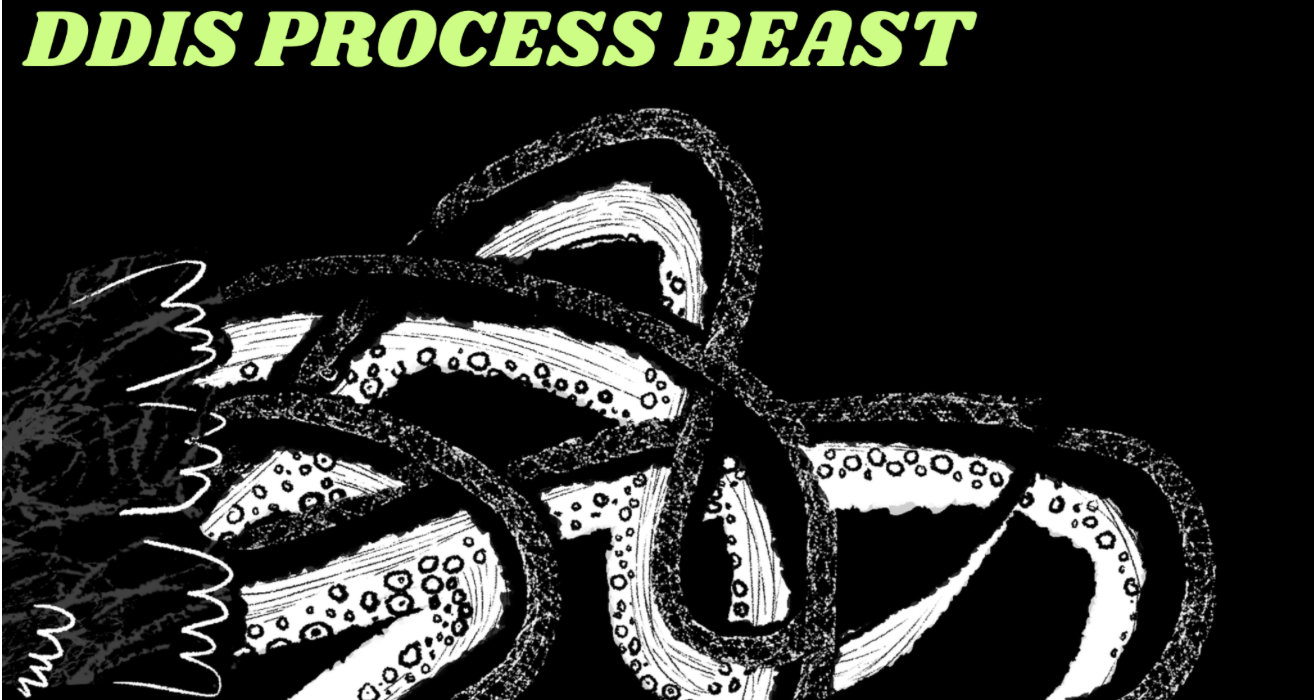
Graphic of the Beast by Emily Soussana
The project
I had the privilege of being a researcher on the DDIS (Digital Dramaturgy Integration Strategy) conceived by Playwrights’ Workshop Montréal in partnership with potatoCakes_digital and with support from the Canada Council for the Arts. The project involved a long-form process supporting artist collaborators across the creation of 4 new Canadian live performance works focused on digital experimentation. It was led by digital dramaturgs Andrew Scriver and Emily Soussana (potatoCakes_digital) in collaboration with the following PWM dramaturgs: Fatma Sarah Elkashef, Aki Matsushita, and Leila Ghaemi. The collaborating creators/playwrights on the project were: Amanda Smith, Maxime Corbeil-Perron, Gillian Stone, Panthea Vatandoost, Scout Rexe, Emma Tibaldo and Lois Brown. A core facet of the project was its more than two-year duration, as well as the funds, time, and resources allocated to artists to foster experimentation and ongoing conversations across several workshops.
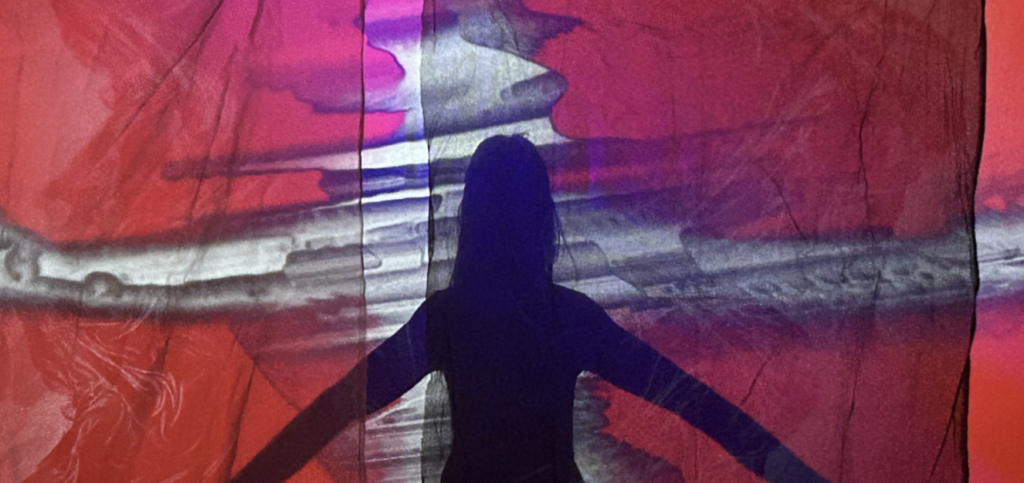
Dramaturg Aki Matsushita in the Blood Moon process
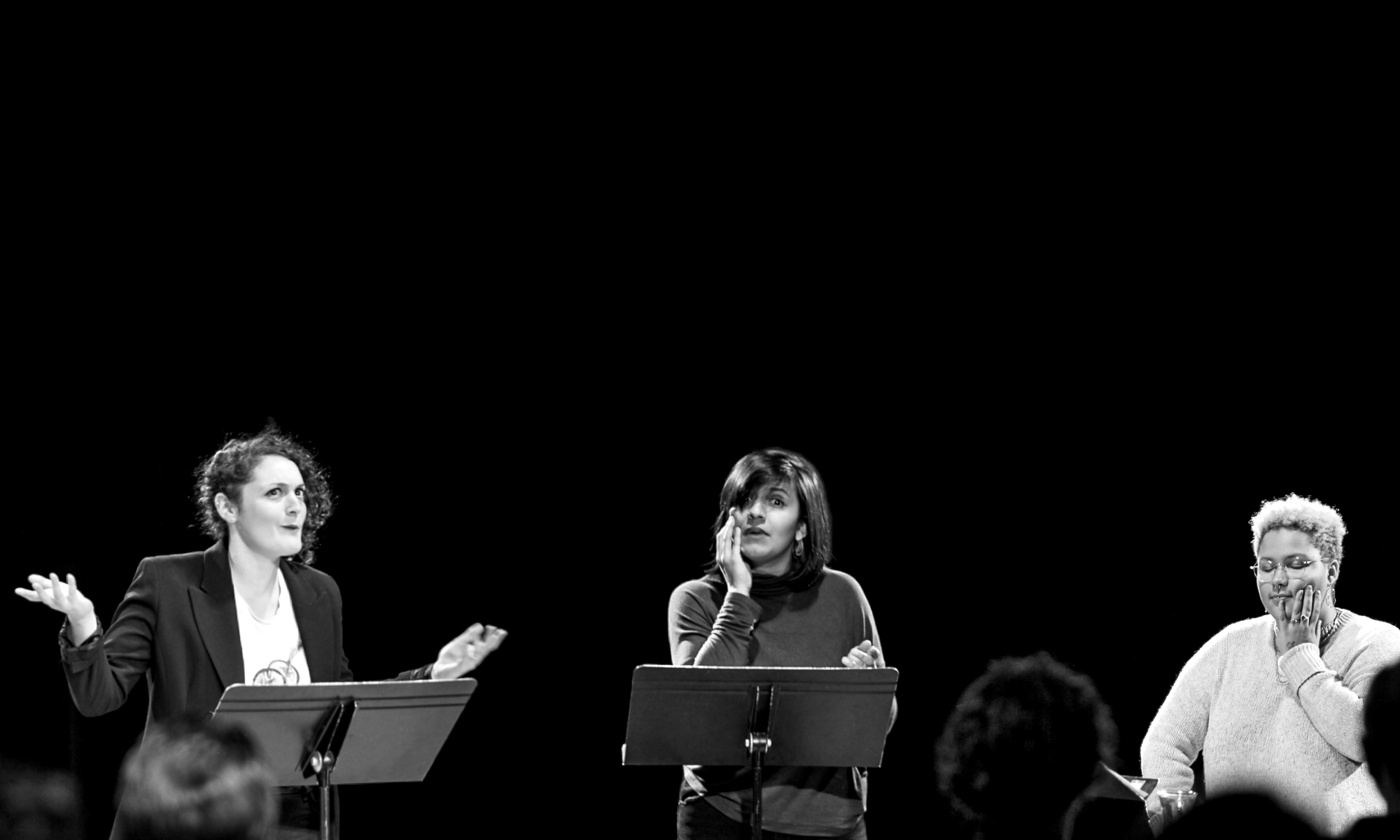
The project also involved interviews with external artists and organizations whose work is informed by digital art to deepen the project and the team’s insights into digital processes in other sectors/disciplines. These external consultants included: Amy Chartrand (freelance narrative strategist;NFB: digital arts), Andrea Peña and Bobby Léon (digital arts, film and choreography), SAT (digital arts), Rilla Khaled (Concordia/TAG), Oasis Immersion (digital arts), Nadia Ross: STO Union (digital arts and theatre) and Kyungseo Min: Blizzard (narrative writing for video games). The DDIS process concluded with a public event in PWM’s studio that featured digital installations related to the process across all 4 workshops and a one-hour panel discussion with the project’s creators and dramaturgs.
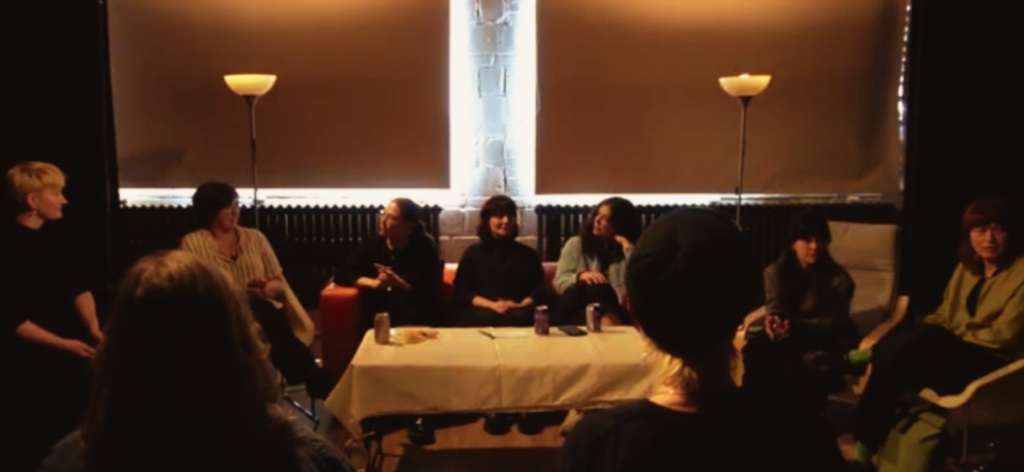
Panel discussion at PWM
DDIS aimed to explore the dialogue, questions, conversations, prototypes and connections that can emerge at the intersection of dramaturgical and creation practices and digital technology.
We decided to name the project’s research outcome a “process beast” because of its various generative, sensing, evolving, and open-ended tentacles. The research work began in a more closed and conclusive container. We felt the need to broaden and open the research’s structure in favour of the “process beast,” because we felt its tentacles spoke to the porosity, sensitivity and agility needed for ongoing, process-centred learning.
Context and Care
Over the course of the DDIS process, I became pregnant, birthed my son (a beautiful sweetie named Lawrence), and navigated the choppy and, at times, seemingly impossible waters of postpartum. PWM and potatoCakes_digital decided to keep me on the project, and they were incredibly accommodating, gentle and caring with me in this first tender year.
The DDIS team also ensured that another collaborating artist had a dark room to nurse in during her workshop. I will forever be grateful to PWM for being so understanding and flexible to this new artist parent. It is hopeful to know that this is possible in the arts. I want to sincerely thank interim DDIS researchers Tiernan Cornford and Madeline Scovil who stepped in with incisive insights and questions during my maternity leave. Thank you for your work.
The learning and impact
The learning (around process, collaboration, dramaturgy, experimentation, interdisciplinary work, modes of communication and ways of thinking about and approaching creation) was endlessly rich throughout this process. It is hard to fully take inventory of the impact DDIS has had on my life and practice. It is also nearly impossible to clearly define dramaturgy, let alone digital dramaturgy. I do think an attempt to reach at different articulations, definitions and perspectives of the practice is important. Sharing and making process visible feels essential to generative exchange.
With this articulation and sharing around process in mind, let’s move on to the beast.
SHARING RESEARCH: Excerpts from The Process Beast
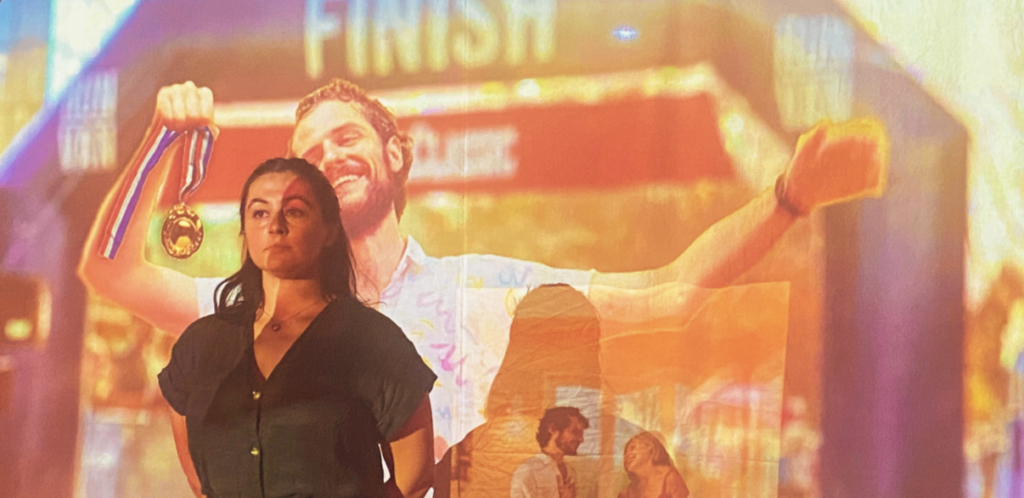
Actor Cara Rebecca in the Cult Play process
The Four Workshops
DDIS provided long-term dramaturgy to 4 projects at different stages of development. The workshops involved digital explorations with: audio-visual experiments, the genre of horror, live and projected translation and explorations with language, the impact of analog and digital technologies on memory and storytelling, the narrative tension that can exist between live and pre-recorded digital materials, possibilities of inclusive livestreamed performances, experimentation with illusion and architecture to convey dissociation and embodied emotion, and the role movement tracking can play in conveying setting and mood.
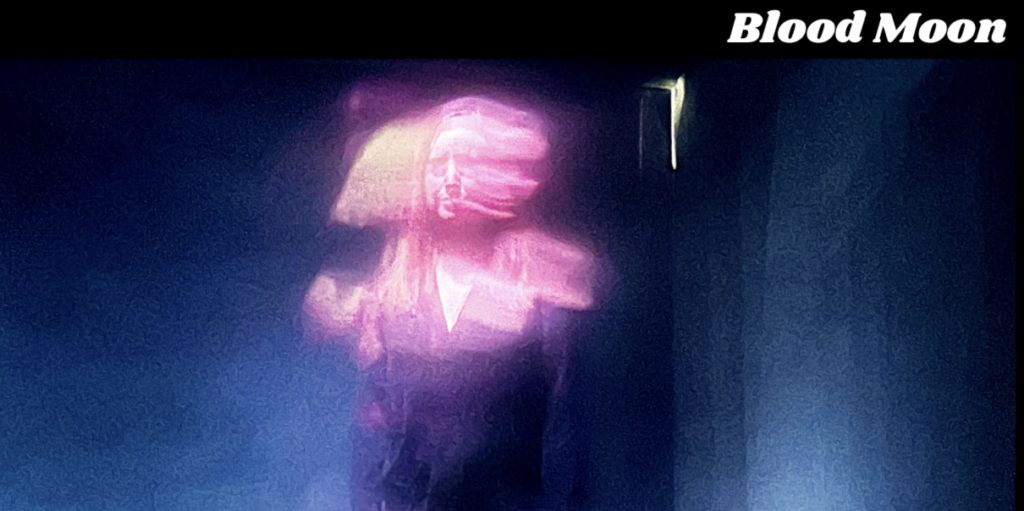
Singer Jacqueline Woodley in the Blood Moon process
Research Methods
As a researcher, the methods I used to gather information throughout DDIS were: mind maps of key themes in each workshop; open-ended questions; overheard dialogue and conversations during the workshop process; recurring interviews with artist collaborators, external artists and organizations, and participating dramaturgs; and observation of rapid prototyping or media sketches from potatoCakes_digital that were created as part of each workshop’s development process and archived throughout the duration of the DDIS.
A process log was created for each workshop.
You can view one for the Blood Moon creation process here.
Excerpts from conversations with artist collaborators and dramaturgs
Ongoing conversation is essential to a dramaturgical practice and collaboration. Here are some excerpts from the dramaturgs and creators/playwrights who participated in the DDIS process.
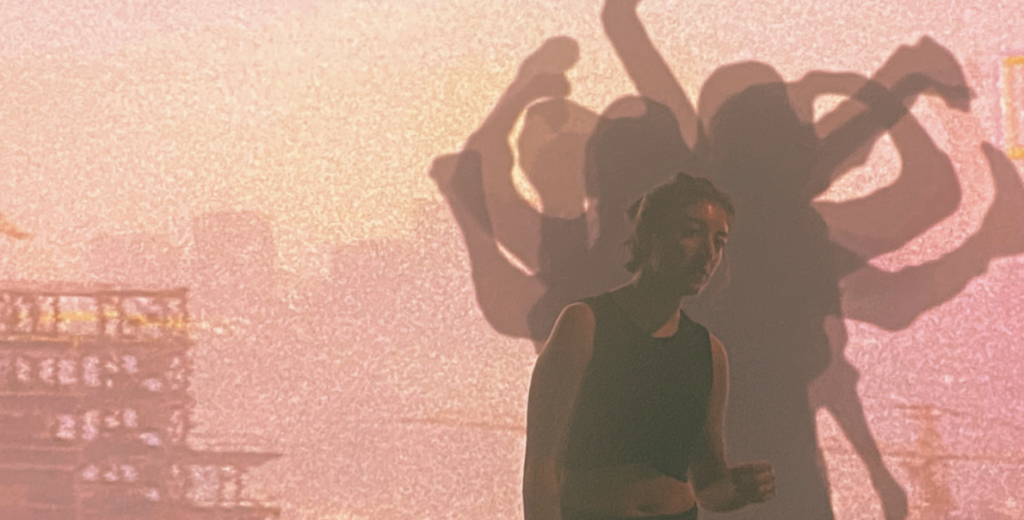
Actor Kimia Pourazar in the Zaboon process
On the Cult Play process
SCOUT:
It’s transformative to get dramaturgical support that is curious, holistic and flexible rather than being prescriptive in a way that looks for a neat and tidy way of answering a question for a playwright. Creating outside of the pressures of production… that dramaturgical
support can provide a beneficial kind of companionship; a creative companionship in an endeavour that’s so existential. – Playwright, Cult Play
On the Blood Moon process
GILLIAN:
I do have forms of synesthesia that I work with internally. So to have that projected outside and to be informed by other brains, to have this external kind of synesthesia, it’s something I haven’t really done before. So that was really cool. Working in this way really expanded so much of this project.” –Gillian Stone, Blood Moon co-creator
AKI:
For Blood Moon, it was a very unconventional way of working. The affective explorations built with the singer in the room were especially interesting. I could see the anxiety build up as I watched the performer behind the scrim. I felt very open and receptive. It was a process that pushed me not to overprepare. It was one of those rare occasions where I’m responding in the moment. Not to a story or text yet. I wasn’t getting too heady. It was the excitement of starting from a premise that is not necessarily narrative-based. Through sound and projection mapping. Through exploring distortion as well. Exploring the feeling of a piece. Having an understanding of this feeling physically and viscerally before understanding what story we’re following. –Dramaturg on the Blood Moon process.
On the Invisible Me process
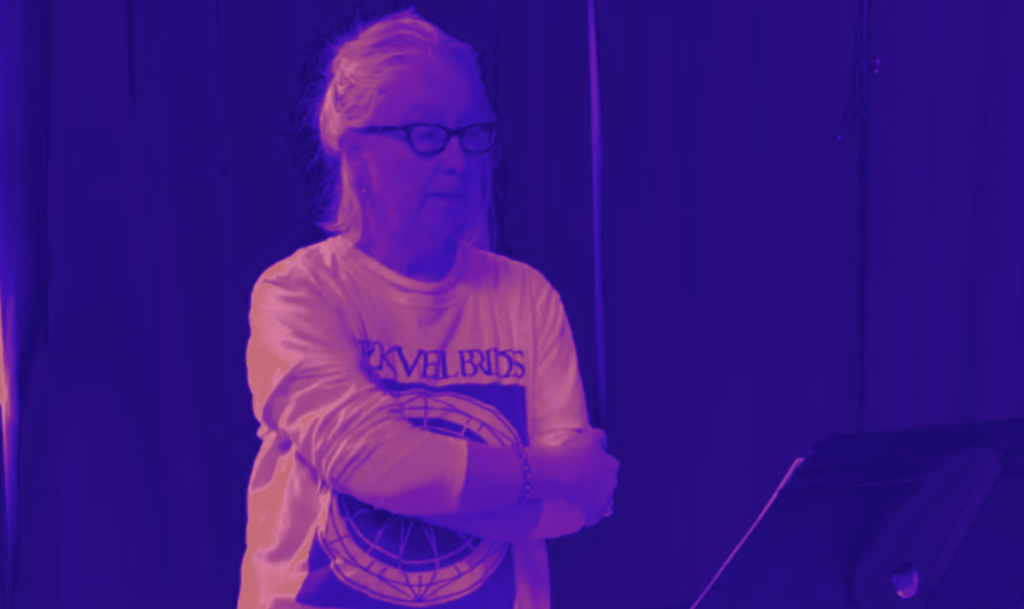
Playwright/co-creator/performer Lois Brown in the Invisible Me process
LOIS:
We were really not sure how all of the equipment would work. It looks like we would have to rehearse it in a studio and then compact it down into a rig that could fit in my bedroom or downstairs, which would be made to look like my bedroom. Then I could do a performance from my house. A live Zoom. A digital format. It would also include some objects that are not live, and by objects I mean pieces of animation and design. Recordings. It’s interesting, when something is recorded I don’t think of it as me anymore. – Lois Brown, Invisible Me playwright/performer
EMMA:
I think some of the false starts in terms of what kind of animation or technology was needed, what effect we were looking for…this was the dramaturgy. It was trying something and figuring out that wasn’t the way we wanted it to go. That also helped to simplify the text. It helped me figure out the order of everything. I do think that one of the biggest lessons for me was keeping the playwriting at the centre of it. I think reading the script every day recentered us because you didn’t come in with any idea of what the play was, but more of a concrete understanding of the play that day. – Director and Dramaturg for Invisible Me
On the Zaboon process
LEILA:
I think there is a lack of preciousness with digital dramaturgy. With kind of throwing stuff at the wall. It forces us to do the doing rather than the talking, which I think is great. It’s more than visual. It’s six senses. I operate with the six senses in a way where I try to create an ecosystem. I like to revisit Small Planet by Eleanor Fuchs to discover the six senses of a piece. To explore the initial impulses. I think digital dramaturgy is a tool. A tool for the six senses. –Leila Ghaemi, Dramaturg on Zaboon
RESEARCH FINDINGS AND OBSERVATIONS
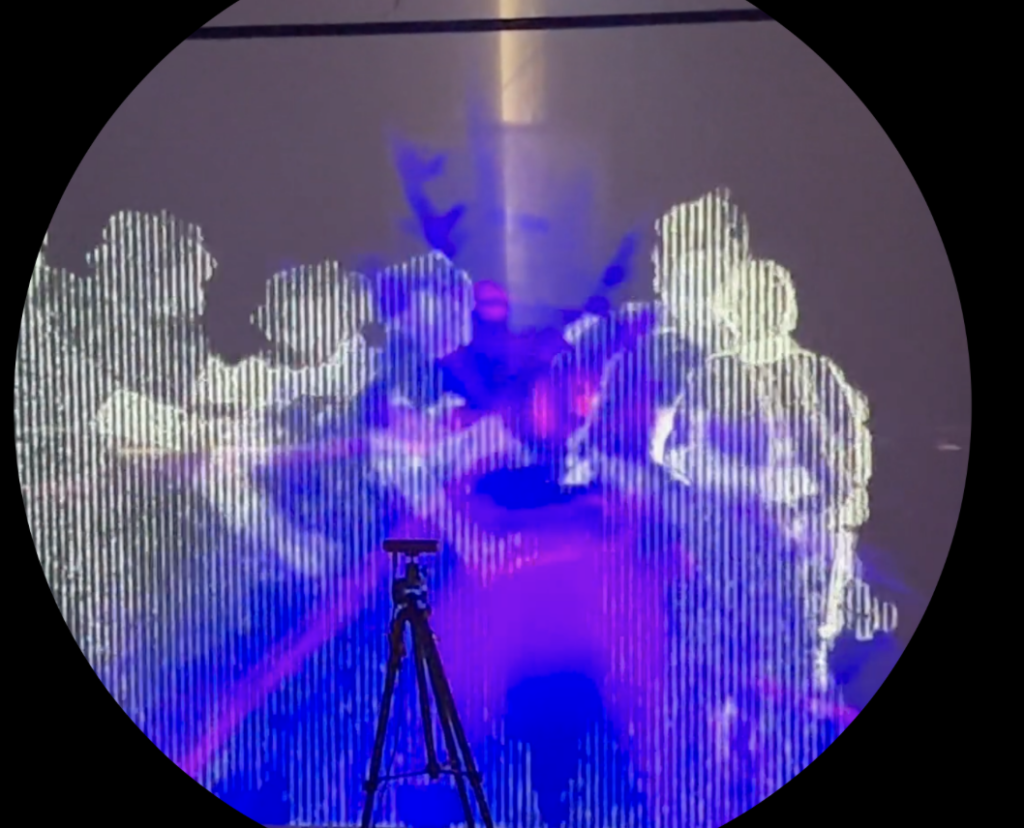
Director/Creator Amanda Smith in the Blood Moon process
After reviewing observations, conversations, questions, and prototypes from the DDIS project, the following two key dramaturgical findings emerged in connection with the “process beast” that exists at the intersection of digital and other forms of dramaturgical creation practices: experimental and holistic collaboration, and sensory worldbuilding.
We observed that experimental and holistic collaboration was explored through: 1) a lack of scarcity made possible through institutional support and funding 2) rapid prototyping (with writing and digital design) that embraced improvisation, failure, experimentation and trial and error 3) a shared vocabulary and group cohesion established through room set-up, choice of collaborators, and a structured container for experimentation and ongoing conversations before, during and after the workshops 4) fluidity between roles and disciplines: a willingness to work across disciplinary and role-oriented codes towards the goal of each collaborator working dramaturgically.
We observed that sensory worldbuilding was explored through:
Spatial thinking and memory as story structure
1) an architectural way of thinking about story (plot, character, setting theme, style, form and stage space. For ex: exploring the layering of 2D and 3D spaces 2) a third space: an exploration of the storied third space that occurs when digital and analog stage spaces overlap, collaborate and interact 3) illusion, memory and perspective: explorations of memory, the subconscious and the spectrum of reality and the surreal.
Visual and auditory landscapes as story structure
We observed that the collaboration between digital dramaturgy and other forms of dramaturgical collaboration catalyzed a unique visual and sonic vocabulary that could be used as the building blocks for story or as prompts for collaboration in the creation work. Some of the observed visual/narrative techniques involved in that storied world-building are:
1) juxtaposition: of visual media, digital and analog stage space, and sound 2) imagery, colour and metaphor as story through visual and audio media 3) rhythm, pattern and repetition through visuals and sound as a narrative structure
These observations represent tentacles of the beast and are by no means conclusive.
We hope that they continue to offer a container or touchpoint for future dialogue about process.
On attempting to articulate digital dramaturgy:
These words point at articulating, but not too cleanly or narrowly defining, digital
dramaturgy. This is an ongoing articulation. A living list of possibilities. This text was built by
researcher Erin Lindsay in response to the DDIS process.
Digital dramaturgy is…
a rich dramaturgical approach to sensory world building
a generative, spatial, visual and auditory method for holistic experimentation
an often design-based prompt for collaboration, creation and a lateral way of working
a sometimes non-verbal way to engage with a play and creator or collaborative team
a space for exploration of texture, genre, architecture, emotion, theme, plot, structure;
all the interlocking elements of a play or performance experience
a way to explore the relationship between form, medium, media and writing
a proposal, a challenge, a collaboration, a process and an observation
a mycelium network of evolving relationships, questions and conversations
a reaching and tentacled way of working, creating and seeing
Thank you for exploring process with us.
We will be sharing the full website with more research questions, findings and digital archives in the near future, so stay tuned!
Sincerely,
A dramaturgical nerd.
The Digital Dramaturgy Integration Strategy was made possible through the support of the Canada Council for the Arts.