Digital Dramaturgy Integration Strategy (DDIS): The Process Beast

A reflection on process written by DDIS researcher, Erin Lindsay

Graphic of the Beast by Emily Soussana


I had the privilege of being a researcher on the DDIS (Digital Dramaturgy Integration Strategy) conceived by Playwrights’ Workshop Montréal in partnership with potatoCakes_digital and with support from the Canada Council for the Arts. The project involved a long-form process supporting artist collaborators across the creation of 4 new Canadian live performance works focused on digital experimentation. It was led by digital dramaturgs Andrew Scriver and Emily Soussana (potatoCakes_digital) in collaboration with the following PWM dramaturgs: Fatma Sarah Elkashef, Aki Matsushita, and Leila Ghaemi. The collaborating creators/playwrights on the project were: Amanda Smith, Maxime Corbeil-Perron, Gillian Stone, Panthea Vatandoost, Scout Rexe, Emma Tibaldo and Lois Brown. A core facet of the project was its more than two-year duration, as well as the funds, time, and resources allocated to artists to foster experimentation and ongoing conversations across several workshops.

Dramaturg Aki Matsushita in the Blood Moon process 

The project also involved interviews with external artists and organizations whose work is informed by digital art to deepen the project and the team’s insights into digital processes in other sectors/disciplines. These external consultants included: Amy Chartrand (freelance narrative strategist;NFB: digital arts), Andrea Peña and Bobby Léon (digital arts, film and choreography), SAT (digital arts), Rilla Khaled (Concordia/TAG), Oasis Immersion (digital arts), Nadia Ross: STO Union (digital arts and theatre) and Kyungseo Min: Blizzard (narrative writing for video games). The DDIS process concluded with a public event in PWM’s studio that featured digital installations related to the process across all 4 workshops and a one-hour panel discussion with the project’s creators and dramaturgs.

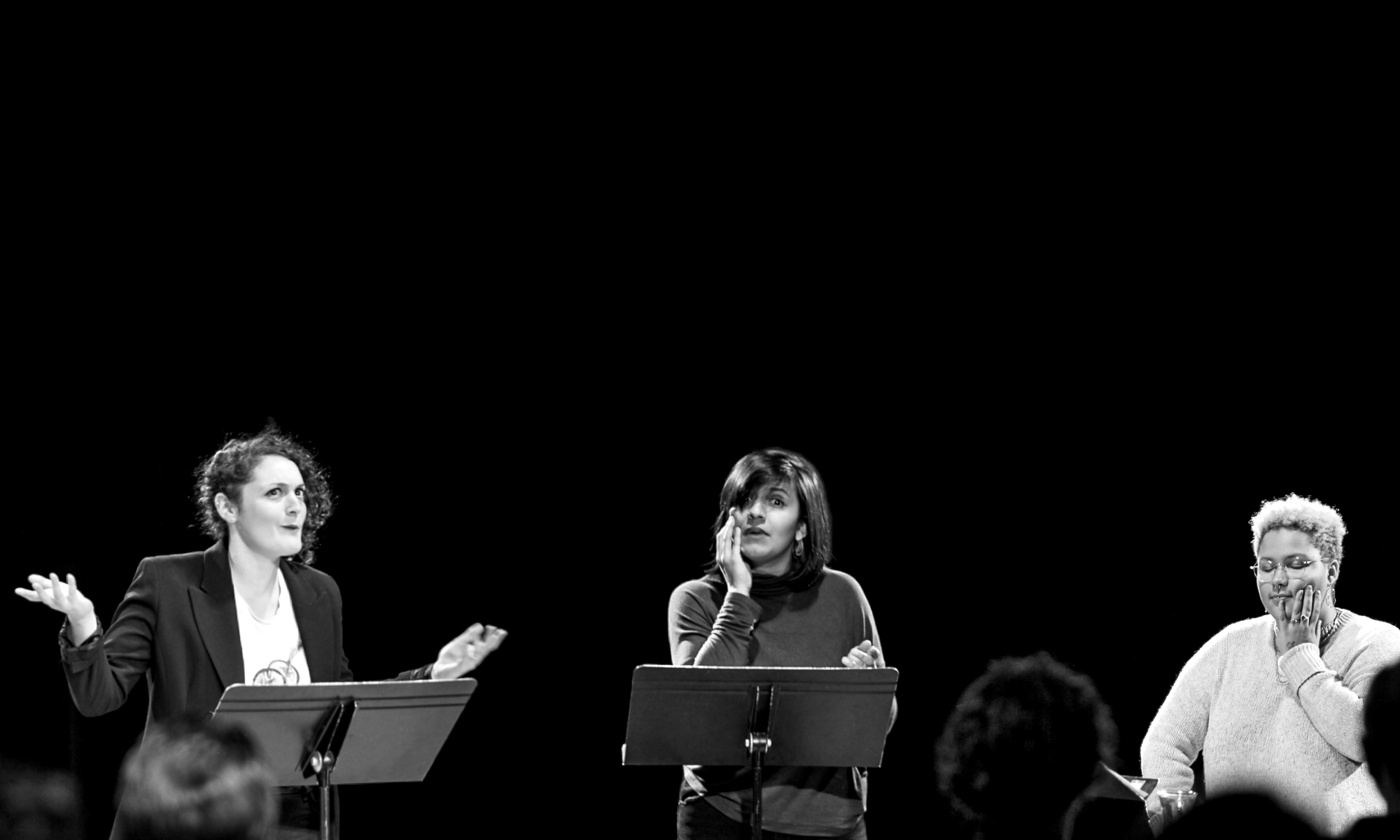
Panel discussion at PWM

DDIS aimed to explore the dialogue, questions, conversations, prototypes and connections that can emerge at the intersection of dramaturgical and creation practices and digital technology. 

We decided to name the project’s research outcome a “process beast” because of its various generative, sensing, evolving, and open-ended tentacles. The research work began in a more closed and conclusive container. We felt the need to broaden and open the research’s structure in favour of the “process beast,” because we felt its tentacles spoke to the porosity, sensitivity and agility needed for ongoing, process-centred learning. 

Over the course of the DDIS process, I became pregnant, birthed my son (a beautiful sweetie named Lawrence), and navigated the choppy and, at times, seemingly impossible waters of postpartum. PWM and potatoCakes_digital decided to keep me on the project, and they were incredibly accommodating, gentle and caring with me in this first tender year.

The DDIS team also ensured that another collaborating artist had a dark room to nurse in during her workshop. I will forever be grateful to PWM for being so understanding and flexible to this new artist parent. It is hopeful to know that this is possible in the arts. I want to sincerely thank interim DDIS researchers Tiernan Cornford and Madeline Scovil who stepped in with incisive insights and questions during my maternity leave. Thank you for your work. 

The learning (around process, collaboration, dramaturgy, experimentation, interdisciplinary work, modes of communication and ways of thinking about and approaching creation) was endlessly rich throughout this process. It is hard to fully take inventory of the impact DDIS has had on my life and practice. It is also nearly impossible to clearly define dramaturgy, let alone digital dramaturgy. I do think an attempt to reach at different articulations, definitions and perspectives of the practice is important. Sharing and making process visible feels essential to generative exchange. 

With this articulation and sharing around process in mind, let’s move on to the beast. 

Actor Cara Rebecca in the Cult Play process

DDIS provided long-term dramaturgy to 4 projects at different stages of development. The workshops involved digital explorations with: audio-visual experiments, the genre of horror, live and projected translation and explorations with language, the impact of analog and digital technologies on memory and storytelling, the narrative tension that can exist between live and pre-recorded digital materials, possibilities of inclusive livestreamed performances, experimentation with illusion and architecture to convey dissociation and embodied emotion, and the role movement tracking can play in conveying setting and mood.

Singer Jacqueline Woodley in the Blood Moon process

As a researcher, the methods I used to gather information throughout  DDIS were: mind maps of key themes in each workshop; open-ended questions; overheard dialogue and conversations during the workshop process; recurring interviews with artist collaborators, external artists and organizations, and participating dramaturgs; and observation of rapid prototyping or media sketches from potatoCakes_digital that were created as part of each workshop’s development process and archived throughout the duration of the DDIS.

A process log was created for each workshop.
You can view one for the Blood Moon creation process here.

Ongoing conversation is essential to a dramaturgical practice and collaboration. Here are some excerpts from the dramaturgs and creators/playwrights who participated in the DDIS process.

Actor Kimia Pourazar in the Zaboon process


SCOUT:

It’s transformative to get dramaturgical support that is curious, holistic and flexible rather than being prescriptive in a way that looks for a neat and tidy way of answering a question for a playwright. Creating outside of the pressures of production… that dramaturgical
support can provide a beneficial kind of companionship; a creative companionship in an endeavour that’s so existential. – Playwright, Cult Play


GILLIAN:
I do have forms of synesthesia that I work with internally. So to have that projected outside and to be informed by other brains, to have this external kind of synesthesia, it’s something I haven’t really done before. So that was really cool. Working in this way really expanded so much of this project.” –Gillian Stone, Blood Moon co-creator

AKI:

For Blood Moon, it was a very unconventional way of working. The affective explorations built with the singer in the room were especially interesting. I could see the anxiety build up as I watched the performer behind the scrim. I felt very open and receptive. It was a process that pushed me not to overprepare. It was one of those rare occasions where I’m responding in the moment. Not to a story or text yet. I wasn’t getting too heady. It was the excitement of starting from a premise that is not necessarily narrative-based. Through sound and projection mapping. Through exploring distortion as well. Exploring the feeling of a piece. Having an understanding of this feeling physically and viscerally before understanding what story we’re following. –Dramaturg on the Blood Moon process.

Playwright/co-creator/performer Lois Brown in the Invisible Me process 

LOIS:

We were really not sure how all of the equipment would work. It looks like we would have to rehearse it in a studio and then compact it down into a rig that could fit in my bedroom or downstairs, which would be made to look like my bedroom. Then I could do a performance from my house. A live Zoom. A digital format. It would also include some objects that are not live, and by objects I mean pieces of animation and design. Recordings. It’s interesting, when something is recorded I don’t think of it as me anymore. – Lois Brown, Invisible Me playwright/performer 

EMMA:

I think some of the false starts in terms of what kind of animation or technology was needed, what effect we were looking for…this was the dramaturgy. It was trying something and figuring out that wasn’t the way we wanted it to go. That also helped to simplify the text. It helped me figure out the order of everything. I do think that one of the biggest lessons for me was keeping the playwriting at the centre of it. I think reading the script every day recentered us because you didn’t come in with any idea of what the play was, but more of a concrete understanding of the play that day. – Director and Dramaturg for Invisible Me 

LEILA:

I think there is a lack of preciousness with digital dramaturgy. With kind of throwing stuff at the wall. It forces us to do the doing rather than the talking, which I think is great. It’s more than visual. It’s six senses. I operate with the six senses in a way where I try to create an ecosystem. I like to revisit Small Planet by Eleanor Fuchs to discover the six senses of a piece. To explore the initial impulses. I think digital dramaturgy is a tool. A tool for the six senses. –Leila Ghaemi, Dramaturg on Zaboon

Director/Creator Amanda Smith in the Blood Moon process 

After reviewing observations, conversations, questions, and prototypes from the DDIS project, the following two key dramaturgical findings emerged in connection with the “process beast” that exists at the intersection of digital and other forms of dramaturgical creation practices: experimental and holistic collaboration, and sensory worldbuilding.
We observed that experimental and holistic collaboration was explored through: 1) a lack of scarcity made possible through institutional support and funding 2) rapid prototyping (with writing and digital design) that embraced improvisation, failure, experimentation and trial and error 3) a shared vocabulary and group cohesion established through room set-up, choice of collaborators, and a structured container for experimentation and ongoing conversations before, during and after the workshops 4) fluidity between roles and disciplines: a willingness to work across disciplinary and role-oriented codes towards the goal of each collaborator working dramaturgically. 

We observed that sensory worldbuilding was explored through: 

1) an architectural way of thinking about story (plot, character, setting theme, style, form and stage space. For ex: exploring the layering of 2D and 3D spaces 2) a third space: an exploration of the storied third space that occurs when digital and analog stage spaces overlap, collaborate and interact 3) illusion, memory and perspective: explorations of memory, the subconscious and the spectrum of reality and the surreal. 

We observed that the collaboration between digital dramaturgy and other forms of dramaturgical collaboration catalyzed a unique visual and sonic vocabulary that could be used as the building blocks for story or as prompts for collaboration in the creation work. Some of the observed visual/narrative techniques involved in that storied world-building are:

1) juxtaposition: of visual media, digital and analog stage space, and sound 2) imagery, colour and metaphor as story through visual and audio media 3) rhythm, pattern and repetition through visuals and sound as a narrative structure 

These observations represent tentacles of the beast and are by no means conclusive.
We hope that they continue to offer a container or touchpoint for future dialogue about process. 

These words point at articulating, but not too cleanly or narrowly defining, digital
dramaturgy. This is an ongoing articulation. A living list of possibilities. This text was built by
researcher Erin Lindsay in response to the DDIS process.

a rich dramaturgical approach to sensory world building

a generative, spatial, visual and auditory method for holistic experimentation

an often design-based prompt for collaboration, creation and a lateral way of working

a sometimes non-verbal way to engage with a play and creator or collaborative team

a space for exploration of texture, genre, architecture, emotion, theme, plot, structure;

all the interlocking elements of a play or performance experience

a way to explore the relationship between form, medium, media and writing

a proposal, a challenge, a collaboration, a process and an observation

a mycelium network of evolving relationships, questions and conversations

a reaching and tentacled way of working, creating and seeing

Thank you for exploring process with us.

We will be sharing the full website with more research questions, findings and digital archives in the near future, so stay tuned!

Sincerely,
A dramaturgical nerd.

The Digital Dramaturgy Integration Strategy was made possible through the support of the Canada Council for the Arts.
Canada Council logo


Young Creators Unit 2026-2027 Call for Applications

A graffiti-like background of blue, turquoise, and black. On the left side, the words Young Creators Unit 2026-2027, Call for Applications. On the top right, the PWM logo in white.
Calling all emerging playwrights and theatre creators: The 2026-2027 Young Creators’ Unit is now accepting applications!

Offering theatremakers innovative workshops, 1:1 consultations, and group activities that focus on creation, dramaturgy, and professional development, applications for the 12th edition of the Young Creators Unit program are now open!

Application deadline: Sunday, July 19, 2026, 11:59PM EST.
All applicants will receive a response by August 16, 2026. 

If you have any questions regarding accessibility, require assistance with this application, or would like to discuss alternative methods of applying, please contact accessibility@playwrights.ca.

“I’ve loved being in this year’s Young Creators Unit. Leila facilitates our cohort with a fervent loyalty towards our plays and what our writing wants to say. Here I have learned to revere my creative impulses and to lean on my peers’ expertise. Leila, the other YCU playwrights, and the theatre professionals I’ve met during our outings have made me feel like my play has found its home in this city. Thank you PWM!”

— Hanesa Banks (’26)

About the Young Creators Unit

Are you a theatre maker under 30, looking to hone your craft in storytelling? Do you have a brilliant idea for a play, but are not sure how to get it on paper? Or maybe you need feedback and guidance to elevate your first draft to the next level?

If any of this sounds like you, then PWM’s Young Creators Unit is the place to develop your craft. This creative incubator supports emerging artists to find their voice, make connections, and learn new storytelling skills, all while developing the practical skills they need to establish a successful career in the arts. All you need to apply is an idea, question, theme, image, or more! 

The YCU will once again be led by PWM’s Artistic Producer & YCU Dramaturg, Leila Ghaemi. From September 2026 -June 2027, participants will receive 1:1 dramaturgical sessions with Leila, mentorships with industry professionals, and group writing sessions and workshops. YCU participants are also provided professional development resources and opportunities, such as grant writing support and guidance, access to local theatre experiences and performances, and networking opportunities. 

The program will run from September 9th, 2026, to June 2nd, 2027. Group sessions will take place weekly on Wednesdays from 5-8PM in the PWM Creative Studio, located at 7250 Rue Clark, suite #103.

If you are interested in learning more about the Young Creators Unit and PWM, or about the YCU 2026-2027 Application process, please email Leila at leila@playwrights.ca.

PWM welcomes all applications. While recognizing that the identity of each person is fundamentally plural, and multidimensional, we strongly encourage applications from artists who are: Indigenous (First Nations, Métis, and Inuit), Black, POC, racialized (including recent immigrants), 2SLGBTQQIPAA+, neurodivergent, living with disability, chronic illness and/or chronic pain. PWM is strongly committed to supporting a wide range of cultural identities and lived experiences, therefore we encourage applicants to self-identify in their application if they are comfortable doing so.

Eligibility 

  • Be an artist aged 30 or younger;
  • Be a Canadian citizen or hold permanent residency status in Canada;
  • Be located in Montreal and able to attend sessions in person; 
  • Be available for the whole program, September 2026 – June 2027;
  • Be willing to participate in group activities during the program.

How to Apply

If you are interested in applying, please fill out this Google Form by 11:59 PM EST by July 19th, 2026. Your application will require the following information:

  • A brief bio of yourself, and your experience as a storyteller/creator.
  • A brief description of the work you would like to develop (writing and / or artistic samples are encouraged).
  • A brief description sharing why you would like to join the Unit, and what you hope to get out of the experience.
  • Any additional writing and/or artistic materials you would like to have considered with your application. This can be a current script excerpt, mood boards, music playlists, past work, etc.

This helps us get to know you and what sparks your interest as an artist and how you might fit into the YCU ensemble!

Due to the high level of interest in the YCU each year, we will be holding interviews with some of the potential candidates  to learn more about their interests and goals, and what they hope to gain from the program. This is also a great opportunity for you to ask us questions! Please note that not all applicants will be contacted for an interview, and that an interview does not indicate whether or not you have been accepted into the program.

The number of Cohort members we can accept are limited. Participants are expected to attend the group sessions, 1:1 meetings,  as well as commit to additional self-directed activities. Please only apply to the Unit if you are able to commit to the full intensive schedule. All applicants will be informed of their results by Sunday, August 16th, 2026.  Click here to preview the application form as a PDF.

The Selection Process

Once the application period is closed, all applications will be reviewed and considered by a selection committee. Please note that there are many factors that go into the selection process, such as group dynamics and the range of experiences and points of views within the Cohort. Decisions will not be based on training or competencies; we therefore encourage applications from all backgrounds and experience levels.

If you have any questions, please contact YCU’s Lead Dramaturg, Leila Ghaemi, at leila@playwrights.ca

YCU is led by PWM’s Artistic Producer & Dramaturg, Leila Ghaemi.

Leila Ghaemi (she/her) is a proud Persian dramaturg and theatre educator.  She received her BFA in Theatre Arts and MFA in Theatre Education & Direction from Boston University’s School of Theatre, where she trained in dramaturgical methods. Having spent over a decade working for various theatre organizations in the United States and Canada, Leila has been fortunate to evolve her artistic practices professionally and academically, specifically in new play development. Her artistic pillars include MENASA representation, radical theatre empowerment, and creating diverse, equitable, and inclusive spaces on and off stage. Leila also serves on the board for Persephone Productions Montreal. When not dreaming about theatre, her world revolves around her pit-pug puppy Gigi and her two very sassy cats: Leslie & Hiccup.

Learn more about the Young Creators Unit.


The YCU is made possible through the generous support of our funders:

Wordmark of the Government of Canada


The 2025-2026 Young Creators Unit Showcase

PWM’S YOUNG CREATORS UNIT IS NOW IN ITS 11TH YEAR, FEATURING A VIBRANT GROUP OF EMERGING MONTRÉAL THEATRE ARTISTS.  

After months of artistic exploration  and discovery, members of this  year’s cohort are preparing for the annual YCU showcase! This private event will take place at the PWM Studio on Thursday June 4th and Friday June 5th at 7:00 PM. This year, each playwright will be featured on both nights.

Learn more about each cohort member featured in this year’s showcase by clicking the “show more” button under their names.

The YCU showcase is a private event due to limited seating capacity. If you are interested in attending, please contact leila@playwrights.ca. Please note that seats are provided based on availability. 

Thank you for supporting Montréal’s emerging artists!


Thursday, June 4 and Friday, June 5


This program is facilitated by YCU Dramaturg, Leila Ghaemi.

Leila Ghaemi (she/her) is a proud Persian dramaturg and theatre educator.  She received her BFA in Theatre Arts and MFA in Theatre Education & Direction from Boston University’s School of Theatre, where she trained in dramaturgical methods. Having spent over a decade working for various theatre organizations in the United States and Canada, Leila has been fortunate to evolve her artistic practices professionally and academically, specifically in new play development. Her artistic pillars include MENASA representation, radical theatre empowerment, and creating diverse, equitable, and inclusive spaces on and off stage. Leila also serves on the board for Persephone Productions Montreal. When not dreaming about theatre, her world revolves around her pit-pug puppy Gigi and her two very sassy cats: Leslie & Hiccup.

THE YOUNG CREATORS UNIT IS FINANCIALLY SUPPORTED BY:
Patrimoine canadien/Canada Heritage logo

Participants of the 2026 Glassco Translation Residency in Tadoussac

A view of the bay in Tadoussac at sunrise.
The Glassco Translation Residency in Tadoussac is taking place from June 17th to the 28th!

Known for encouraging rich, nuanced works, the Glassco Translation Residency fosters a thoughtful and generative translation process, grounded in collaboration and the deep exploration of the ideas woven into each play.

Unique au pays, cette résidence, qui a lieu dans l’historique Maison Fletcher à Tadoussac au Québec, donne aux traducteurs le temps, l’espace et le soutien dramaturgique nécessaires pour la traduction d’une pièce de théâtre.

The program plays a vital role in Canada’s theatre-making landscape, and we’re pleased to announce this year’s playwright-translator pairs. You can click on each participant’s photo to learn more about their work.


La machine à cons | Translation from French to English

Céleste Godin

Translator

Click for participant bio

Annick Lefebvre

Playwright

Click for participant bio

Blissful State of Surrender | Translation from English to French

Sylvie Nicolas

Translator

Click for participant bio

Sanita Fejzić

Playwright

Click for participant bio

Après t’avoir bordé tendrement, je meurs | Translation from French to English

Johanna Nutter

Translator

Click for participant bio

Stéphanie Labbé

Playwright

Click for participant bio


Meet the Translation Dramaturg

We’re pleased to welcome Maureen Labonté as the new Glassco Translation Residency host and translation dramaturg!

Maureen Labonté is a dramaturge, translator and teacher. She has coordinated a number of play development programmes in theatres and play development centres across the country including at the Banff Centre for the Arts, the Centre des auteurs dramatiques (CEAD) in Montreal, the National Arts Centre (Ottawa) and Playwrights’ Workshop Montréal. She has also worked as a dramaturge in many Franco-Canadian theatres, such as the Théâtre du Nouvel-Ontario (Sudbury), Théâtre-Action (Ottawa), the Cercle Molière (Winnipeg) and L’Escaouette (Moncton).

Maureen has also worked extensively as a translation dramaturge. With Emma Tibaldo, she helped set up the Playwrights Workshop Montreal/Cole Foundation Mentorship for Emerging Translators in 2012, and is still involved as mentor and dramaturge. This highly successful programme is now in its eleventh cycle.

Maureen was the Jury Chair for the Siminovitch Prize in Theatre from 2009 to 2012.

From 2006 to 2011, she was Co-Director of the Banff Playwrights Colony at the Banff Center for the Arts. Prior to that, she worked at the Colony as resident dramaturge and then as Head of Program (2002-2005).

Maureen also worked at the National Theatre School of Canada for more than 20 years. In the mid-90’s, she set up and ran a pilot two-year Directing Programme and then went on to coordinate the Playwriting Programme and Playwrights’ Residency. She has taught at NTS-ENT in the Playwriting, Directing and Mise-en-scène programmes.

She now teaches master classes in Text Analysis in both French and English across the Country.

Maureen Labonté has translated more than fifty Quebec plays into English. One of the main focuses of her work has been in the area of Theatre for Young Audiences (TYA). Also, And Slowly Beauty, her translation of Michel Nadeau’s Lentement la beauté was short-listed for the 2014 Governor General’s Award in Translation.

She lives in Montreal.

Meet the PWM Staff Dramaturg and Residency Host

Aki is a biracial, Japanese-Canadian (nisei, second generation) dramaturg and arts educator raised in Ottawa and Tokyo within a family of pedagogues.

Aki’s love for theatre began in her formative years at a francophone Arts High School in Ottawa. She completed a Bachelor’s of Arts specialised in theatre, during that time, she participated in an international exchange studying for a year at the University of Birmingham, UK to immerse herself in English and European Theatre. In the years that follow, Aki completed her Masters of Arts in Theatre Theory and Dramaturgy, successfully defending her Thesis that examined the Intercultural Adaptations of Japanese Post-War Theatre Director, Suzuki Tadashi. Since moving to Montreal Aki has worked with emerging theatre artists in training at the National Theatre School of Canada.

Aki is fascinated by intercultural performance, as it fosters an exchange and seeks out connection between seemingly disparate entities, looking at the world through the lens of wanting to understand each other’s humanity across geographic, cultural, linguistic, temporal and cultural boundaries. Intercultural performance resonates deeply with Aki as a bi-racial artist whose mixed-identity has always been a centre point of her existence.

Aki has been engaging in dramaturgical collaboration apprenticeships for a number of years following her studies. Since joining PWM, Aki has collaborated with a number of artists in developing their projects and is continuously discovering new elements of her artistic process with every new collaboration.


About the Residency

The Glassco Translation Residency in Tadoussac is dedicated to the art of translation for the stage.

Tout au long de son histoire remarquable, cette résidence a servi de cadre à la traduction de pièces de théâtre en plusieurs langues, notamment en cri, en cantonais, en espagnol, en catalan, en portugais, en tagalog, en anglais et en français.

The Glassco Residency logo -- a hand-drawn line underneath two thick pathways.

The Glassco Translation Residency in Tadoussac is made possible through our partnership with the Cole Foundation’s Intercultural Conversations Program, the dedication of Residency Producer Briony Glassco, and the support of the friends and family of the great Canadian theatre artist, Bill Glassco. We are also grateful to the Canada Council for the Arts, the Conseil des arts et des lettres du Québec, and the Conseil des arts de Montréal for their ongoing support.

Logo of the Cole Foundation
friends and family of Bill Glassco
Canada Council logo
CALQ_logo
CAM Logo

Queer Reading Series 2026

A background of colours ranging from blue to pink and pastel orange. On the left, written in white, the words Queer Reading Series. On the bottom right, the dates May 14 & 15, 2026. On the top right, PWM and Centaur Theatre logos.

JOIN US IN CELEBRATING QUEER THEATRE AT THE 2026 QUEER READING SERIES.

PWM, in partnership with Centaur theatre, invites you to join us for two readings of dynamic new works-in-progress by Queer artists. The Queer Reading Series continues for its 6th year amplifying the voices of early-career 2SLGBTQIA+ playwrights. 

On May 14 and 15  at 7:30PM, Centaur Theatre will host Not Just Empty Space by Sarah Danielle Pitman and Dylan’s Song by Anna Morreale. Each performance will be followed by a conversation with the creative team.

The Queer Reading Series is a FREE event. Donations help us keep our programming free to artists, and will be gratefully accepted at the door.

Both readings will be presented with English captions, and the conversations will be presented with auto-generated captioning, for accessibility purposes.

Join us to uplift exciting new works-in-progress and support Queer voices exploring the intersections of queerness and artistic practice.


Schedule

thursday, may 14th at 7:30PM:

Not Just Empty Space
by Sarah Danielle Pitman.
Directed by Trevor Barrette.

Performed by Alyssa Angelucci-Wall and Gabrielle Banville.

Dramaturgy by Fatma Sarah Elkashef and Aki Matsushita.

Kitty Hawk, 1903: a fifteen-year-old girl attempts to photograph the Wright Brothers’ first flight.

Just outside the Earth’s orbit, 2103: an astronaut thrown from their spaceship drifts aimlessly through the universe.

Right here, right now: two unnamed collaborators argue over how to weave these stories together for the stage.

A work of historical and speculative drama, Not Just Empty Space explores connections through time, as well as our own expectations of theatrical storytelling.


friday, may 15th at 7:30PM:

Dylan’s Song
by Anna Morreale.
Directed by Annie Valentina.

Dramaturgy by Erin Lindsay.
Choreography by Scott McCabe.

Performed by Anastassia Chepelkevitch, Lior Maharjan, and Micha Raoutenfeld.

Producing support by Lily Chang.

Poetry. Drama. Dance. Dylan is numb. She has been trying to achieve something beyond herself for years: going to raves every weekend, using ketamine everyday, and giving her body to anyone that wants it. After the death of a lover, and a near psychotic episode on the dancefloor, Dylan decides to quit the scene – but not without one final night out. Alongside her chorus of beautiful bodies, Dylan dances through her memories of last night’s last rave, discovering just how dark her desires have really become. And what her mind tries to forget, her body forces her to remember.

Content advisory:
Self harm, drug use, overdose, mentions of blood and bodily harm.


About the Playwrights

Sarah Danielle Pitman is a playwright who grew up on the unceded territories of the Lekwungen and W_SÁNEC nations. Now based in Tiohtià:ke/ Montreal, she is a graduate of the playwriting program at Canada’s National Theatre School where her play Salvage The Wrecked was produced for the New Words Festival. Sarah’s play Lay Down All Dogs was presented as a staged reading at the Centaur Theatre for their 2026 WinterWorks Festival, and her theatre-for-young audiences show Beyond Belief is currently touring schools around Quebec and the Maritimes as part of Geordie Theatre’s 2Play Tour.

Anna Morreale is a multidisciplinary artist and recent alum of the CBC Actors Conservatory at the Canadian Film Centre. Since graduating from the National Theatre School of Canada in 2021, Anna has been working professionally in the theatre, film and voice acting industries. Their first introduction to playwriting was through Playwrights’ Workshop Montréal’s Young Creators Unit in 2024, where they began developing their first play: Dylan’s Song. Anna also wrote and starred in their debut short film: NIKITA, produced by the CFC and directed by Jessie Posthumus.


READ MORE ABOUT THE queer reading series.
THIS PROGRAM IS FINANCIALLY SUPPORTED BY:
Canada Council logo
CALQ_logo
CAM Logo

Panel Discussion: Diving in with the DDIS Process Beast

Compilation of photos of DDIS workshops throughout 2024-2026.
Are you curious about the relationship between digital dramaturgy and play/performance development?

Participate in an afternoon of dramaturgical conversation and process exploration at PWM.

May 2nd from 1-4pm at the PWM Studio
7250 Rue Clark #103, Montreal, Quebec, H2R2Y3
This is a free event. Donations are welcome at the door.

Centered around a panel discussion exploring the “process beast” that emerged at the intersection of digital and other forms of dramaturgical collaboration, we will be sharing process and research findings from DDIS: a two year Digital Dramaturgy Integration Strategy project conceived by potatoCakes_digital and Playwrights’ Workshop Montréal with support from the Canada Council for the Arts. 

The panel will feature the DDIS team and collaborating dramaturgs: Fatma Sarah Elkashef, Aki Matsushita, Emily Soussana and Andrew Scriver and playwrights/creators Amanda Smith, Scout Rexe, and Emma Tibaldo and will be moderated by researcher Erin Lindsay.  

The panel will begin at 2:00PM. There will be an opportunity to engage with digital art and installations from the DDIS process along with prompts and questions for continued conversation both before and after the 1 hour panel discussion.

Not able to make the event?
We will be following up with a digital hub of research findings, questions, prompts and observations from the DDIS process. 

The Digital Dramaturgy Integration Strategy was made possible through the support of the Canada Council for the Arts.
Canada Council logo
Accessibility Tools
English (Canada)
Skip to content